Best Web Development Trends Every Kashmir Business Should Know

Most "web development trends" articles are written for developers and quietly repackaged for business owners. You end up reading about rendering strategies and edge runtimes and being left with the impression that you're behind on something, without ever being told what it would change for you.
So let me set a filter before we start, and hold everything below to it: a trend is only worth your attention if it changes how many customers find you, how many of them act, or how much the site costs you to run. Everything that fails that test is somebody else's hobby.
By that standard, most of what gets called a trend isn't one. But a handful of genuine shifts have landed in the last two years, and they matter more for a business in Srinagar or Anantnag or Baramulla than they do for a business in Bengaluru — because the constraints here are different, and a few of these changes happen to line up neatly with those constraints.
This guide walks through the ones that pass the filter, what each one means in plain language, what it looks like when it's done right, and how to check whether your current site has it. It's written from eight years of building and maintaining sites for businesses in the valley — hotels, houseboats, schools, clinics, exporters, manufacturers, retailers — so the examples are the ones I've actually had to solve.
If you're still at the stage of choosing who builds the thing, start with the web development companies in Kashmir guide instead, then come back here. This article assumes you either have a site and want to know what it's missing, or you're about to commission one and want to specify it properly.
At a glance
- AI answers are now a discovery channel of their own. Being ranked and being cited have separated. Structure, schema and answer-shaped content decide the second one.
- Speed became a measurable revenue line, not a vanity score. Google's INP metric measures responsiveness after the page loads — the exact thing that felt broken on mid-range Android phones on a valley 4G connection.
- Server-first rendering is the new default, and it's the single largest free performance win available to a rebuild.
- Mobile-first quietly became app-like. Installable sites, offline resilience and thumb-reachable navigation now do most of the job businesses used to commission a native app for.
- AI on a website stopped being a gimmick the moment assistants started completing tasks — quoting, booking, answering in Urdu or Kashmiri — instead of deflecting them.
- Automation is where the money actually is. WhatsApp, UPI, CRM and invoicing wired into the site removes hours of manual re-typing every week.
- Measurement changed shape. Pageviews are close to worthless; counting qualified enquiries by source is the only reporting that survives contact with a budget conversation.
- Privacy became a legal obligation, not a footer link, under India's data protection regime.
- Adoption order matters more than adoption itself. The last section gives you a sequence by business type, so you don't spend on trend nine while trend four is broken.
Four things that make Kashmir different
Generic trend advice assumes a generic market. Ours isn't, and four local realities change which trends pay off first.
 Snow-line, water and a working market in one frame — the valley's mix of seasonal demand and mobile-first customers changes which web development trends actually pay off
Demand is sharply seasonal, and the shape differs by sector. Tourism, hospitality and transport compress a year of enquiries into a handful of months. Handicraft and horticulture exporters peak against buying calendars abroad. Education spikes around admissions. That seasonality has a direct technical consequence: your site has to be finished and indexed before the season, not during it. Search visibility has a lag of months. A hotel that commissions a website in April has already lost the summer.
Your traffic is overwhelmingly mobile, and often not on great bandwidth. Not every visitor is on a flagship phone with full-strength 5G. A heavy site that feels fine on your developer's laptop can be genuinely unusable on a four-year-old Android in a hotel lobby in Pahalgam. This is why the performance trends below aren't optional here — they're closer to a functional requirement.
Buying is conversational and WhatsApp-first. A large share of enquiries in the valley never touch a contact form. Somebody sees a phone number, saves it, and messages. Any design that treats the contact form as the only conversion path is measuring a fraction of its own performance.
Trust has to be earned before contact, not after. Buyers here — and especially buyers outside here, evaluating a Kashmiri supplier or hotel from another state or country — are making a judgement about legitimacy from the website alone. Real photographs, a real address, real reviews and a site that loads instantly do more for conversion than any amount of animation.
Hold those four in mind. They're the reason my ranking of these trends differs from what you'd read on a global blog.
Part one: the trends that change who finds you
1. AI answer engines became a real discovery channel
The biggest change in search since I started building sites isn't a ranking-algorithm tweak. It's that a growing share of questions now get answered rather than listed. Someone asks an AI assistant which houseboat operators on Dal Lake handle international bookings, or which firm builds inventory software for a Srinagar distributor, and gets a short synthesised answer naming two or three businesses.
If you're not one of the named businesses, the ranking you worked for never gets seen.
 The visibility question has split in two — ranking in a list of links, and being named inside a synthesised answer
The practical work of being citable overlaps heavily with good SEO, but not completely. What actually moves it:
- Answer-shaped content. A page that states its answer in the first two sentences and then justifies it is far more quotable than one that builds to a conclusion in paragraph nine. This is a writing change, not a technical one, and it's the cheapest item on this entire list.
- Structured data that describes reality.
LocalBusiness,Service,FAQPage,Product,ReviewandBreadcrumbListschema give a machine unambiguous facts — your address, hours, service area, prices, ratings — instead of asking it to infer them from your layout. - Facts that agree with each other everywhere. Your name, address and phone number on the site, on your Google Business Profile, on directories and on your invoices must be byte-identical. Contradictory facts are the fastest way to be dropped from an answer, because a model with two versions of your phone number will usually cite neither.
- Genuine specificity. "We provide quality service" is unciteable. "We ship pashmina to the EU with GI certification and handle customs documentation" is a fact somebody can repeat.
- A machine-readable summary of your site. An
llms.txtfile — a plain summary of what your business does and where the important pages are — is cheap to add and increasingly worth having.
None of this replaces conventional search. Both channels are fed by the same underlying work, which is why the twelve-month SEO roadmap is still the right sequencing document even in an AI-search world.
2. Local search turned into a comparison engine
The second shift is subtler. Local results used to be a list of nearby businesses. They now function as a comparison table: rating, review count, review recency, photos, hours, response time, and increasingly a summary of what reviewers actually said.
That reframes what you're optimising. You aren't trying to appear — you're trying to win the comparison once you appear. Concretely, that means the review pipeline is now a development concern, not just a marketing one. Requesting reviews should be built into your post-sale flow. Responding to them should be a weekly habit. And the site should carry the same reviews, marked up with Review schema, so the proof is visible to somebody who lands directly on your homepage without going through Google at all.
The mechanics of getting this right in a valley context — service-area pages, category selection, photo cadence, the Google Business Profile fields most businesses leave blank — are in the local SEO checklist for Srinagar businesses and, at a strategy level, in how to rank Kashmir businesses on Google.
3. Content shifted from announcing to answering
A decade ago a business website described the business. Now it has to answer the questions a customer would otherwise ask a person.
The pages that earn traffic and enquiries in 2026 are the ones that take a real buying question seriously and answer it completely: what this costs and why it varies, what the process actually looks like week by week, what could go wrong, who this isn't for. That last one matters more than people expect — telling a visitor honestly when you're not the right fit is the single most persuasive thing you can put on a page, because it's the only claim on the entire site that costs you something to make.
This is also the trend with the widest gap between effort and result. It needs no new technology at all. It needs you, or someone who has actually done the work, sitting down and writing what you'd tell a customer across a desk.
Part two: the trends that change what a visitor experiences
4. Performance stopped being a score and became a revenue line
Google's Core Web Vitals now include INP — Interaction to Next Paint — which replaced the older FID metric in 2024. The distinction matters. FID measured how quickly a page acknowledged your first tap. INP measures how long it takes to actually show you a result, across every interaction on the page.
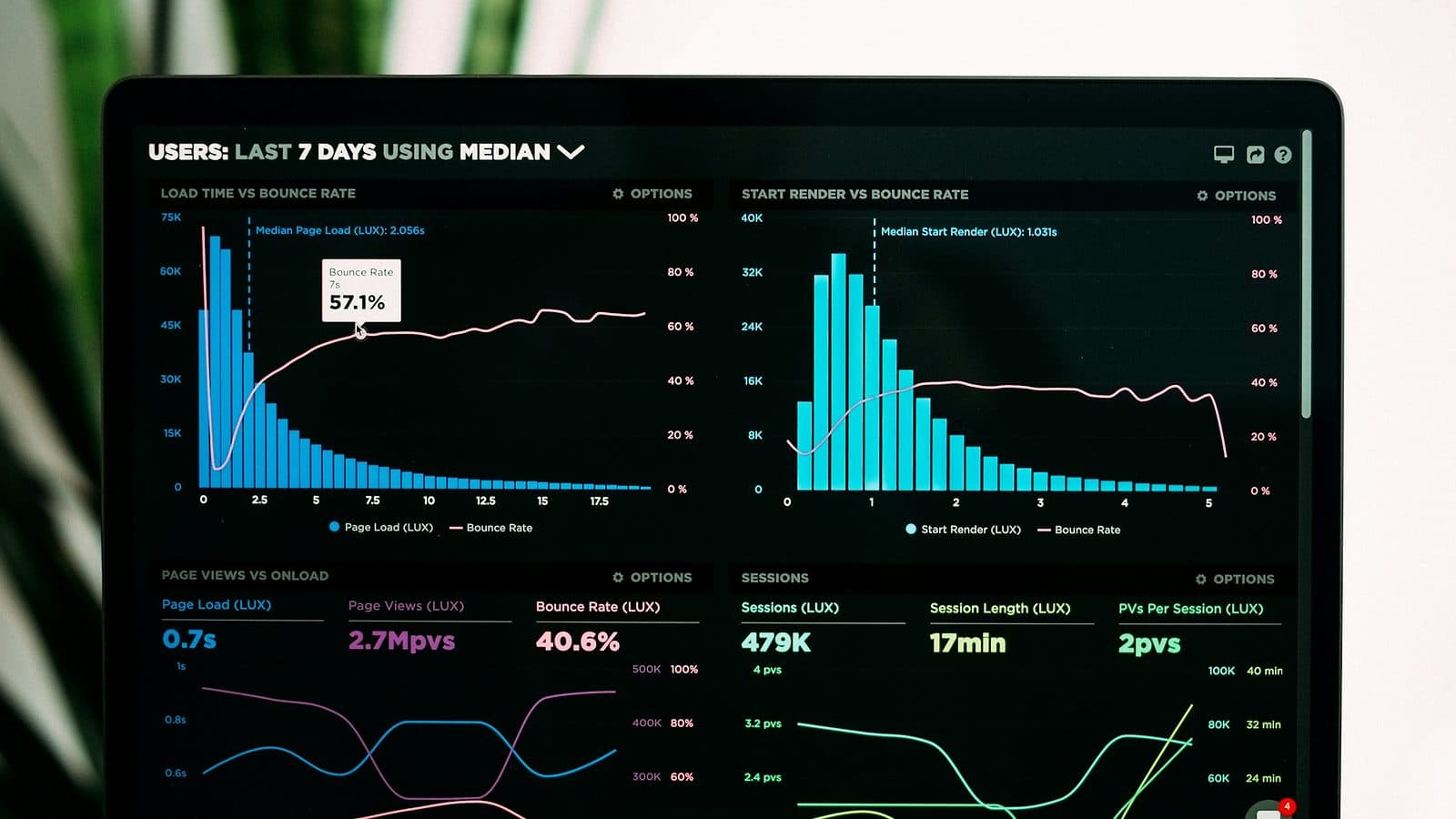 Load time, bounce rate and session length side by side — performance is a measurable business number, not a vanity score
INP is precisely the metric that captures the experience most people in the valley have on a heavy website: you tap the menu, nothing happens, you tap again, the menu opens twice. That's not a slow connection. That's a main thread choked by too much JavaScript — usually a page builder, a slider plugin, three analytics scripts and a chat widget all competing.
The targets worth writing into a brief:
| Metric | What it measures | Good |
|---|---|---|
| LCP | How long until the main content appears | Under 2.5s |
| INP | How responsive the page is to taps and clicks | Under 200ms |
| CLS | How much the layout jumps while loading | Under 0.1 |
What actually achieves them is unglamorous: modern image formats served at the size they're displayed, fonts self-hosted and preloaded, third-party scripts audited ruthlessly, and shipping less JavaScript in the first place. If you want to see where your own site currently stands before commissioning anything, run it through the website authority checker — it's free, and it gives you a baseline you can hold a developer to afterwards.
One caution, because it's the most common way this goes wrong: performance is not a one-off fix. A site tuned to a Lighthouse score of 98 will drift back into the seventies within a year if plugins and tracking tags get added without discipline. Treat it as a standing budget, not a launch task.
5. Server-first rendering became the sensible default
This is the most technical item here, and I'll keep it short, because what matters to you is the consequence rather than the mechanism.
 A modern component-based codebase — server-first rendering is where most of the free performance in a rebuild comes from
For roughly a decade the fashion was to send a mostly-empty page to the browser and let JavaScript assemble it. It made for slick interfaces and slow first loads, and search engines had to work harder to read the result. The industry has swung back: modern frameworks now render on the server by default and send the browser finished HTML, adding interactivity only to the parts that genuinely need it.
Three things follow from that, all of which you can feel:
- The first paint is dramatically faster, especially on mid-range phones — which is most of your audience.
- Search engines and AI crawlers see complete content immediately, rather than depending on executing your JavaScript successfully.
- Hosting costs less and survives spikes better, because most pages can be served as pre-built files from a CDN close to the visitor.
I build on Next.js and React for exactly this reason, and it's why a modern web application starts fast rather than being optimised into being fast later. If you're weighing that against a page-builder or a no-code platform, the honest trade-offs are laid out in custom build vs WordPress vs no-code — there are real cases where WordPress is the right answer, and I say so there.
6. Mobile-first quietly became app-like
Responsive design solved the problem of a site fitting a phone. It never addressed a site feeling like it belongs on one. That's the gap current design practice is closing, and it's the trend I'd push hardest for a valley business.
 Most of your traffic arrives like this — one thumb, a mid-range phone, an imperfect connection
What "app-like" concretely means:
- Navigation within thumb reach. A fixed bottom bar with three to five destinations, rather than a hamburger menu in the top corner that requires a hand-shuffle to reach.
- Installability. A properly configured web app manifest lets a customer add your site to their home screen. It then opens full-screen with your icon, with no browser chrome and no app store involved.
- Offline resilience. A service worker can cache your key pages so that a visitor on a patchy connection sees content instead of a dinosaur. In this region that is not a nicety.
- Transitions that imply structure. Moving between pages with a slide or fade rather than a white flash makes a site feel considered. It costs almost nothing and is disproportionately noticed.
- Honest tap targets. Everything interactive at least 44px, real spacing between adjacent links, forms that bring up the right keyboard.
Here's the commercially useful part: this covers most of what businesses in the valley commission a native app for, at a fraction of the cost and with none of the app-store friction. Before you budget for an app, read website vs mobile app — for the large majority of local businesses the answer is a properly built progressive web app, and a genuine mobile application only earns its cost in a few specific situations, which that article names.
7. Design systems replaced page-by-page design
The visible trend of the moment is a particular aesthetic — bento grids, glass surfaces, restrained gradients, generous type. The durable trend underneath it is structural: sites are increasingly built from a design system, a defined set of colours, type scales, spacing units and reusable components, rather than each page being designed from scratch.
The business consequences are real. New pages take days rather than weeks because they're assembled from parts that already exist. The site stays visually coherent as it grows instead of accumulating four slightly different button styles. And a rebrand becomes a change to a handful of variables rather than a rewrite.
Motion belongs in this section too, with a warning attached. Scroll animation, hover states and 3D scenes are everywhere right now, and used sparingly they signal care. Used heavily they wreck INP, block the largest content paint, and make the site actively unpleasant for anyone with motion sensitivity. My rule: animation must earn its place by directing attention, it animates only cheap properties, and it disables itself entirely when the visitor's device asks for reduced motion. If a piece of motion drops mobile performance below the targets above, it gets lazy-loaded or cut. No exceptions — including for things I personally think look great.
8. Accessibility became a reach and compliance issue
Accessibility gets filed under compliance and treated as a box to tick. It's more usefully understood as reach: proper heading structure, real contrast, keyboard-operable controls, labelled form fields and alt text on images make a site work for people using screen readers, for older visitors, for anyone in bright sunlight, and — not incidentally — for the crawlers that build search and AI results.
The overlap with SEO is nearly total. A logical heading hierarchy is an accessibility requirement and how a machine understands your page structure. Descriptive alt text serves a screen reader and image search and an AI model summarising your page. You are, in practice, doing this work twice if you treat them as separate projects.
Part three: the trends that change what your website does for the business
9. AI on a website stopped being a gimmick
The first wave of website chatbots were decision trees with a friendly avatar. They frustrated people and deflected enquiries, and businesses were right to be sceptical.
What changed is that assistants can now read your actual content and complete actual tasks.
 The useful shift isn't that a website can chat — it's that an assistant can now read your real content and finish a real task
Where I've seen this genuinely pay for itself in valley businesses:
- Out-of-hours enquiry capture. International buyers and domestic tourists browse across time zones. An assistant that answers substantively at 2am and hands you a qualified lead in the morning is capturing revenue that previously evaporated.
- Language. Answering in English, Hindi, Urdu or Kashmiri without maintaining four separate support processes is a real advantage for a business selling both locally and abroad.
- Repetitive qualification. "Do you ship to the UK?" "What's included in the package?" "Do you have availability in October?" — the questions you answer forty times a week, handled consistently, with the genuinely qualified conversations escalated to you.
- Search across your own content. For a catalogue, a documentation set or a large service list, semantic search finds what a customer means rather than what they typed.
Two honest caveats. An assistant grounded only in your real content is useful; one improvising is a liability, and getting that boundary right is most of the engineering. And an assistant is only as good as the content behind it — if your site doesn't clearly state your shipping policy, neither will your chatbot. The implementation detail is in AI chatbot development, and the broader question of where AI actually earns its place in a small business is in AI agents for business.
10. Automation moved from nice-to-have to the main return
This is the trend I'd bet on hardest for established businesses in Kashmir, and the one least likely to appear in a design-led pitch.
Most local businesses run on a chain of manual re-typing. An enquiry arrives on WhatsApp. Someone copies it into a spreadsheet. Someone else writes a quotation in Word. A payment lands and gets reconciled by hand. An invoice is created in a separate system. Every one of those handoffs costs time and occasionally loses a customer entirely.
Modern web development treats the website as the front door to that chain rather than a brochure standing beside it:
- Enquiries route themselves — into WhatsApp, email, a CRM and a spreadsheet at once, tagged with the page they came from, so nothing depends on someone remembering.
- Payments happen inline. UPI and card payments, with a receipt generated automatically.
- Bookings check real availability rather than promising a callback.
- Documents generate themselves. Quotations, invoices, confirmations — from data already captured, not retyped.
- Follow-up runs on a schedule. The quiet second and third touch that most enquiries need and most businesses never send.
This is where the return is easiest to calculate honestly, because you can count the hours it removes. If your operations already live in spreadsheets that three people edit and one person reconciles, you're past a website problem — the signs you need custom software covers the threshold, and custom AI and automation solutions covers what replacing it actually involves.
11. Measurement moved from pageviews to attributed leads
 Traffic is not a business number — the reporting that survives a budget conversation counts qualified enquiries by source
Traffic reports are comfortable and nearly useless. The reporting that survives a serious conversation about spend answers four questions:
- How many qualified enquiries came in this month?
- Which page and which channel produced each one?
- How many converted to paying work, and at what value?
- What did it cost to acquire them?
Getting there needs a few deliberate choices at build time. Track events — form submissions, WhatsApp taps, phone taps, magnet downloads — not just pageviews. Attach the source page to every submission so you know which content is actually earning. Use distinct WhatsApp deep links or call-tracking numbers per major page, since the WhatsApp-first buying behaviour in this market means a huge share of conversions are otherwise invisible. And close the loop by recording which enquiries became customers, which usually means the site talking to a CRM.
Add a privacy-respecting analytics setup and a heatmap tool, and you'll typically find within a month that one or two pages are doing most of the work and half the site is doing none. That knowledge is what makes the next round of spending efficient rather than speculative — and it's a standing part of how I approach digital marketing rather than a separate reporting product.
12. Privacy and security became legal obligations
 Consent, data handling and security are now legal obligations with real penalties, not a footer link
India's Digital Personal Data Protection Act has moved data handling out of the "we'll deal with it later" category. If you collect names, phone numbers or email addresses through a website — which is every business reading this — you have obligations around consent, purpose limitation, retention and breach notification, with meaningful penalties attached. Enforcement has been phased, so check where the current requirements stand before assuming you're covered, but the direction is not in doubt.
What this means in build terms is modest and mostly one-off:
- A privacy policy that describes what you actually do, not a template naming a company that isn't yours.
- Explicit consent at the point of collection, with the purpose stated, and no pre-ticked boxes.
- A stated retention period, and a way to honour deletion requests.
- Cookie and tracking consent that actually gates the scripts, rather than a banner that fires them regardless of which button is pressed.
- The security basics: HTTPS everywhere, current dependencies, rate-limited forms, spam protection, no credentials in the codebase, tested backups.
That last point deserves emphasis because it's the most common failure I encounter on inherited sites. Abandoned plugins on an unmaintained install are the usual route in, and the businesses affected are rarely targeted deliberately — they're found by automated scanners. Ongoing maintenance is not an upsell. It's the difference between a website and a liability.
The trends worth deliberately ignoring
An honest trends article has to include the other list.
- Heavy 3D and scroll-jacking on a business site. Spectacular in a portfolio piece, hostile on a mid-range phone. One tasteful hero scene, lazy-loaded, is the ceiling.
- AI-generated content at volume. Search systems and readers are both good at spotting it, and it's the fastest way to make your site indistinguishable from everyone else's. Use AI to research, outline and edit. Don't publish what it drafts unedited.
- Chasing every new framework. The stack matters far less than whether it's maintained and whether whoever inherits it can work in it.
- Blockchain, Web3 and NFT integrations for a hotel, a school or a handicraft store. Still a solution looking for your problem.
- Building a native app before the website works. The most expensive mistake available, and the one I talk businesses out of most often.
- Dark patterns. Fake countdown timers, manufactured scarcity, guilt-tripped opt-outs. They lift conversion briefly and damage trust permanently, and in a market as connected as this one, reputation travels faster than any funnel.
A twelve-point audit of your current site
Do this on your phone, on mobile data, not on your office wifi. It takes about twenty minutes and it will tell you more than any proposal.
- Does the homepage show content in under three seconds on a mobile connection?
- Does tapping the menu respond immediately, or do you tap twice?
- Is the main navigation reachable with one thumb, without shuffling your grip?
- Is there a WhatsApp path, and does it open with a pre-filled message?
- Can you find a price, a range, or an explanation of what price depends on anywhere on the site?
- Does your Google Business Profile show the same name, address and phone as the site, character for character?
- Are there reviews on the site itself, with names and dates, not just anonymous quotes?
- Does the contact form tell you clearly whether it succeeded or failed?
- Do you know how many enquiries the site produced last month, and which pages produced them?
- Is there a privacy policy that describes your business, and does the cookie banner actually gate the tracking?
- Is the certificate valid, and are the platform and plugins current?
- Does any page answer a real customer question in depth, or does every page describe the company?
Fewer than eight yesses and you're not looking at a tune-up. Score it honestly, because the number determines whether the right next step is a fix list or a rebuild — and an honest developer will tell you which, including when the answer is that your current site is worth keeping.
What to adopt first, by business type
Adoption order matters more than adoption itself. Spending on an AI assistant while your site takes nine seconds to load on a phone is a way of making a slow site slower.
 Sequence beats enthusiasm — what to fix first depends on how your business actually gets found and how it gets paid
| Business type | Fix first | Then | Later |
|---|---|---|---|
| Hotel, houseboat, tour operator | Mobile performance, real availability and booking, seasonal content live months ahead | Reviews pipeline, multilingual assistant for out-of-hours enquiries | Automated pre-arrival and follow-up sequences |
| Handicraft or horticulture exporter | Trust signals — provenance, certification, real photography, shipping and customs answered plainly | Product schema, international payments, AI-search citability | Catalogue search, buyer portal |
| School, coaching centre, institute | Fast admissions pages, structured enquiry capture, accessibility | Local search and reviews, parent-facing content that answers real questions | Portal or management system |
| Clinic, diagnostic centre, practice | Local SEO and Google Business Profile, appointment requests, privacy compliance done properly | Performance, service pages that answer patient questions | Reminders and follow-up automation |
| Retail or e-commerce | Mobile checkout speed, UPI, honest delivery and returns information | Product schema, review collection, abandoned-cart follow-up | Personalisation, inventory integration |
| Manufacturer, distributor, B2B | Credible corporate site, specification and documentation pages | Enquiry routing into a CRM, quotation automation | Custom internal software replacing spreadsheets |
If your business doesn't map neatly onto one of these rows, the industries pages break the same logic down further, and the case studies show what the finished version looked like for businesses in similar positions.
How to tell whether your developer actually does this
Trends are easy to claim in a proposal. Six questions separate the people doing this work from the people describing it, and none of them require you to understand code.
 The questions that separate doing this work from describing it — ask them before you sign anything
- "Show me a site you built, and let me open it on my phone on mobile data." Not a screenshot. A live URL, opened on your device, off wifi. This one question filters more providers than the other five combined.
- "What Core Web Vitals do you target, and how do you keep them there after launch?" A specific answer with numbers and a maintenance plan is what you want. "We optimise for speed" is not an answer.
- "Which schema types will my site have, and why those?" They should name types and tie them to your business rather than saying "we do SEO".
- "How will I know how many enquiries the site produced, and from which page?" If the answer is Google Analytics with no event tracking, the answer is no.
- "Who owns the domain, hosting, code repository and analytics when we're done?" The only acceptable answer is you, in your accounts, from day one. Any hesitation here is disqualifying regardless of how good the work looks.
- "What happens after launch, at what cost, and with what response time?" In writing, with hours and a number.
Those overlap with the broader hiring criteria in ten qualities of a professional web developer, and if you're weighing an individual against a firm, the decision framework is in freelancer vs web development company.
What this costs, realistically
Adopting the trends above doesn't mean paying more — it usually means paying differently.
A modern server-rendered site built properly costs about the same to build as a well-made WordPress site and less to run, because it needs less hosting power and fewer paid plugins. The performance work, schema, accessibility and analytics setup add engineering time at build stage and then cost almost nothing to maintain, because they're structural. The genuinely new line items are the ones that do new work: an AI assistant, automation into WhatsApp and a CRM, a booking or quotation system. Those are priced against the hours they remove or the enquiries they capture, and if that arithmetic doesn't clearly favour building them, they shouldn't be built yet.
What does cost more is the ongoing part — maintenance, updates, monitoring, content, and the slow compounding work of SEO. That's the line most quotes leave out and most businesses discover in year two. Current figures by scope for the valley market are in what a website costs in Kashmir in 2026, and if you'd rather price your specific brief than read a range, request a quote and you'll get a scoped number rather than a template.
Frequently asked questions
Do these web development trends actually matter for a small business in Kashmir, or are they for large companies? The first four matter more for a small business than a large one, because a small business has less margin for a website that loses people. Performance, mobile-first navigation, local search and honest content are cheap to get right and directly affect how many enquiries you receive. The later trends — automation, custom software, AI assistants — scale with the size of the operational problem you have. If you don't have that problem yet, don't buy the solution.
My website is three years old. Do I need a rebuild or just an update? Run the twelve-point audit above. Broadly: if the underlying build is sound and the problems are content, speed and search, that's a fix list costing far less than a rebuild. If the site is built on an abandoned theme, can't be edited without breaking, or fails most of the mobile checks, patching it costs more over two years than replacing it. An honest assessment will tell you which, and it's worth getting one before you commit either way.
Is WordPress finished? No, and anyone who says so is selling something. WordPress remains a sensible choice for content-heavy sites with non-technical editors and a properly maintained install. What has changed is that it's no longer the automatic default, and it carries a real maintenance and security obligation. The comparison is set out fairly in custom build vs WordPress vs no-code.
How long does it take to see results from a new website? The site itself performs immediately — speed, clarity and conversion improvements show up in enquiries within weeks. Search visibility is slower: expect early movement in local search within two to three months and meaningful competitive rankings over six to twelve. Anyone promising ranked positions in thirty days is either inexperienced or counting on you being so.
Do I need an AI chatbot on my website? Only if you're answering the same questions repeatedly, losing out-of-hours enquiries, or serving customers across languages or time zones. If you get four enquiries a week and answer them all personally within an hour, an assistant adds nothing. Be sceptical of anyone who recommends one before asking about your enquiry volume.
Will a faster website really increase my sales? It reliably reduces the number of people who leave before seeing anything, which is the largest and most invisible leak on most sites. Whether that becomes sales depends on what they find once they stay. Speed removes an obstacle; it doesn't substitute for a clear offer, credible proof and an easy way to make contact.
Should I hire someone in Kashmir or work with a firm outside the valley? For most business websites, web applications and internal software, the tools and standards are identical everywhere and publicly documented — the address doesn't determine the engineering. What a local partner brings is market context, availability in your working hours, and accountability you can act on. The trade-offs are covered in why businesses prefer local developers over agencies.
What's the single highest-return change for most businesses here? Making the site genuinely fast on a mid-range phone, and making the WhatsApp path obvious and tracked. Between them they usually surface enquiries a business didn't know it was losing, and neither requires a rebuild.
The short version
Filter every trend through one question: does it change who finds you, whether they act, or what the site costs to run?
By that test, four things matter most for a business in Kashmir right now, and they matter in this order. Be fast on a mid-range phone on mobile data, because that's who your visitors actually are. Be findable and citable in both conventional search and AI answers, which is the same underlying work of structure, schema and honest content. Make contact effortless and measurable, especially over WhatsApp, so you stop losing enquiries you never knew you had. Then automate the manual chain behind it — the retyping, the quoting, the follow-up that never gets sent.
Everything else on this list is real, and worth doing, and secondary to those four.
If you want to know where your site stands, start with the free website authority checker and the twelve-point audit above. If you'd rather have someone look at it properly, send me the URL and I'll tell you straight which of these trends your site is missing, which ones would actually pay for themselves in your business, and which ones you can safely ignore — including the times when the answer is that your current site is fine and your money is better spent elsewhere.
You can also see what I build, browse the work, and read what clients say about working this way.
Owais Noor
Full-Stack Developer & Digital Marketer, based in Srinagar. I write about building fast, useful websites and software — and getting them found.