Ecommerce Website Development Services in Kashmir

Kashmir makes things the rest of the world wants to buy. Saffron that sells for more per gram than silver. Pashmina that takes a weaver months. Walnut wood, papier-mâché, willow bats, dry fruits, honey, kahwa, copperware. There is no demand problem here.
There is a distribution problem. Most of that inventory still reaches its buyer through an Instagram DM, a WhatsApp voice note, a screenshot of a bank account, and a courier receipt photographed on a shop counter. It works — until it doesn't scale, until a customer in Dubai asks whether you ship there, until somebody in Delhi wants a GST invoice, until you realise you spent four hours yesterday answering the same three questions.
An ecommerce website is what you build when you're tired of being the bottleneck in your own business.
This guide is about building one properly, in the specific conditions we have here: mobile-heavy traffic, mixed bandwidth, buyers who prefer to chat before they pay, seasonal demand, and a customer base split between the valley, the rest of India, and a diaspora abroad that would buy far more from you than it currently does. I've been building websites, stores and custom software for businesses across the valley since 2018 from Lal Chowk, Srinagar — so what follows is what has actually worked, including the parts that cost money and the parts that are usually a waste of it.
If you're still deciding whether you need a store at all, or whether a simple website is enough, start with website vs mobile app and what a website costs in Kashmir in 2026. If you already know you're selling online, keep reading.
At a glance
- An ecommerce website is not a catalogue with a Buy button. It's a system: product data, payments, shipping rules, tax, order management, and follow-up. The Buy button is the smallest part.
- Four business models sell online, and they need different builds. D2C brand store, catalogue-plus-enquiry, marketplace-plus-own-store, and B2B wholesale portal. Building the wrong one is the most expensive mistake on this page.
- Photography is the single highest-return line item. For handicraft and food, it beats design, and it usually beats ads.
- UPI is the default, but COD still decides conversion for a large share of Indian buyers. A store that ignores either one leaves money on the table.
- WhatsApp is not a fallback — it's a sales channel. Stores here that wire it in properly convert better than stores that treat the checkout as the only path.
- Speed is a revenue number. Your buyer is on a phone, often on mobile data, often outside a city.
- Shipping and returns policy is a conversion feature, not legal boilerplate. Vague delivery information is the most common silent killer of Kashmiri stores.
- Platform choice matters less than people think, and ownership matters more. The details are below, with a table.
- Budget honestly: roughly ₹35,000–₹1,50,000 for most first stores in the valley, with the range driven by catalogue size and integrations, not page count.
- Selling to the diaspora is the biggest unclaimed opportunity most valley businesses are sitting on.
 A vendor poling a shikara loaded with produce through Srinagar's floating market — commerce here has never lacked product, only distribution
Why Kashmir is an unusually good ecommerce market — and an unusually badly served one
Four things make selling online from here different from selling online from Bengaluru, and each one changes what your store needs to do.
Your product has a story that survives shipping. This is rarer than it sounds. Most ecommerce is undifferentiated — you're competing on price and delivery speed against people who will always beat you on both. A Kashmiri saffron producer, a pashmina weaver, a walnut-wood workshop is selling something with provenance, craft and geography built in. That's a genuine moat, and it means your store's job is not to be the cheapest result. It's to be the most credible one. Design, photography and copy do more for you here than a discount code ever will.
Your buyers are mostly not in Kashmir. The valley market matters, but the money is outside it — metro India, the Gulf, the UK, North America, and a large emotionally invested diaspora that actively wants to buy from home and mostly can't find a way to do it that feels safe. Every one of those audiences has different payment habits, delivery expectations and trust thresholds. A store designed only for a Srinagar customer will underperform badly with all of them.
Trust is the conversion bottleneck, not price. There is a well-earned wariness among out-of-state buyers about buying Kashmiri products online, because the category has been flooded with counterfeit saffron and machine-made "pashmina" for years. Your customer's real question is not "is this a good price" — it's "will I get what this photo shows, and can I do anything about it if I don't?" Everything in your store either answers that question or ignores it.
Demand is seasonal and connectivity is uneven. Wedding season, Eid, winter, the tourist months and export buying calendars all spike differently. Your store needs to be live, indexed and ranking before the season, because search visibility lags by months. And your site has to work on a mid-range Android phone on a patchy connection in Anantnag, not just on your developer's laptop.
Hold those four in mind. They're why my advice below sometimes contradicts a generic ecommerce blog post.
First decide which of these four you're actually building
This is the fork in the road, and getting it wrong wastes the entire budget. Most quotes skip this conversation entirely and go straight to "how many products?"
1. The D2C brand store. You own the brand, you sell your own products, you want the customer relationship. Saffron growers, pashmina labels, essential oils, honey, packaged foods, apparel. Full cart, checkout, payments, shipping, order tracking, email follow-up. This is what most people mean by "ecommerce website" and the goal is a brand-led storefront that makes the range feel as premium online as it does in the hand.
2. The catalogue-plus-enquiry store. You have a large or variable-priced range where the customer needs a conversation before buying. Carpets, high-value shawls, furniture, bespoke handicraft, industrial supply. Full product browsing and rich detail pages, but the primary action is an enquiry or a quote request rather than a card payment. Cheaper to build, faster to launch, and for some businesses it converts better — a ₹2 lakh carpet is not an impulse checkout.
3. Marketplace-plus-own-store. You already sell on Amazon, Flipkart, Etsy or Instagram and want your own storefront alongside. The marketplace gives you volume at a punishing commission; your own store gives you margin, customer data and a brand. The build here has to focus on inventory staying in sync and on giving customers a reason to buy direct — usually range, bundles, or provenance the marketplace listing can't carry.
4. The B2B wholesale portal. You sell to retailers, exporters or distributors. Tiered pricing by customer, minimum order quantities, credit terms, GST invoicing, repeat ordering. This is closer to custom software than to a shop — and it's where the largest efficiency gains hide, because you're replacing phone calls and spreadsheets, not just adding a sales channel.
A lot of valley businesses need a blend — a public D2C store with a logged-in wholesale layer behind it. That's a normal, buildable requirement, and it's worth specifying up front rather than bolting on in year two.
The anatomy of a store that actually sells
Everything below is where the money is won or lost. None of it is exotic.
Product pages that answer the objection instead of avoiding it
The product page is where the sale happens. Homepages get admired; product pages get bought from.
A page that converts here carries: a generous set of real photographs, a plain description of what the thing is and what it is not, the specifics a sceptical buyer wants (weight, grade, origin, purity, certification, care instructions), the delivery estimate to their location, the returns position stated in one clear sentence, and reviews from people who bought it.
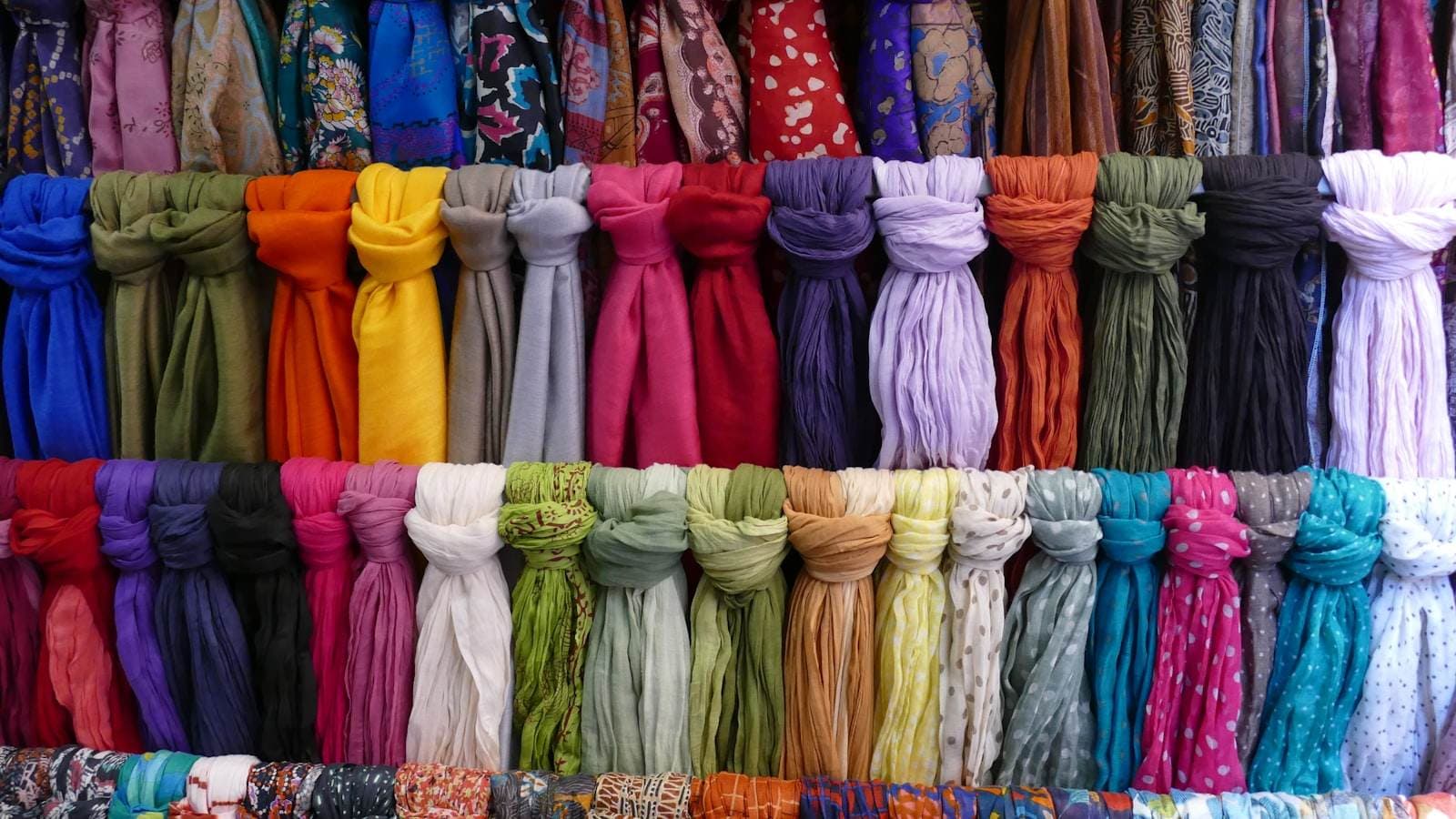 Rows of shawls and scarves stacked by colour — a real catalogue is variants, stock and specification, not just a photo grid
For Kashmiri products specifically, add the thing your competitors won't: proof. GI tag details for pashmina or saffron. Lab test reports where they exist. A photo of the workshop or the field. The weaver's name. The harvest year. Counterfeiting is the category's biggest problem, which means verifiable specificity is your biggest available advantage. "Premium quality" is what the counterfeiters write too. "Grade A1 Mongra, 2026 harvest, Pampore, with a GI certificate number you can verify" is not.
Variants deserve real attention. Size, colour, weight, grade and packaging need to be actual product variants with their own stock counts and prices — not a dropdown that silently sells you something out of stock. Getting variant and inventory structure right at build time is dull work that prevents a year of daily annoyance.
Photography is the budget line most people cut and shouldn't
I'll be blunt: for handicraft, food and apparel businesses in Kashmir, photography returns more per rupee than almost anything else you can buy, including my time. A beautifully engineered store full of dim phone photos on a cluttered counter will underperform an average store with excellent photographs. Every time.
 A product lit and styled for a catalogue shot — the highest-return line item in most Kashmiri ecommerce budgets
What you actually need per product: a clean pack shot on white or a consistent neutral background, two or three detail shots at close range showing weave, grain or texture, one shot showing scale against something familiar, one in-use or styled shot, and — for textiles and food especially — accurate colour. A shawl that arrives a different colour than the photo becomes a return, a refund and a bad review.
This does not require a studio. It requires a window, a sheet of white board, a tripod, a consistent setup and someone willing to be patient. If you'd rather it were handled properly, it sits alongside packaging and brand work under graphic design, and it's worth doing before the store is built rather than after, because the design should be built around your real images.
Checkout and payments: the part where Indian ecommerce is genuinely different
This is where imported advice fails hardest. The Indian payment landscape has its own rules.
 Contactless payment on a phone — UPI has become the default, but it isn't the whole picture
UPI is the default and must be frictionless. For domestic buyers it's the majority of transactions, it settles instantly, and it costs you far less than cards. If your checkout makes UPI feel like a secondary option, you've made your most popular payment method the most awkward one.
Cash on delivery is still a conversion decision, not a technical one. COD raises conversion — sometimes dramatically — among buyers who don't yet trust you, and it brings return-to-origin losses, capital tied up in transit, and fake orders. My usual recommendation: offer it, but manage it. Cap it by order value, restrict it to serviceable pin codes, verify the order with a WhatsApp or OTP confirmation before dispatch, and — this is the part people skip — measure the RTO rate by product and region so the decision to keep or drop it is made with numbers.
Cards, wallets and net banking are table stakes. A payment gateway like Razorpay, Cashfree or PayU covers the domestic set in one integration.
International payments are their own project. If you're selling to the diaspora — and you should be — you need multi-currency display, an international gateway, and clarity about duties and taxes at the destination. This is more compliance work than engineering work, and it's worth scoping deliberately rather than discovering after launch.
The checkout itself should be short, work as a guest, show the total including shipping before asking for payment details, and never surprise anyone with a cost on the final screen. Unexpected shipping cost at the last step is the single most common reason carts get abandoned, and it's entirely self-inflicted.
Speed, on a real phone, on real data
Your buyer is on a phone. Often on mobile data. Often not on a flagship device. A store that takes eight seconds to show a product image has lost a meaningful share of its visitors before they saw anything to want.
The targets worth writing into a contract:
| Metric | What it measures | Target |
|---|---|---|
| LCP | Time until the main content appears | Under 2.5s |
| INP | Responsiveness to taps and clicks | Under 200ms |
| CLS | How much the layout jumps while loading | Under 0.1 |
Hitting these on an image-heavy store is real engineering: modern formats served at display size, lazy loading below the fold, a ruthless audit of third-party scripts, and shipping less JavaScript. It's a large part of why I build on a modern server-rendered stack rather than a plugin stack — the performance is structural rather than something you fight to reclaim. There's more on that shift in web development trends every Kashmir business should know.
You can check where your current site stands right now with the free website authority checker. It takes a minute and gives you a baseline you can hold any developer to afterwards.
The trust layer
Because trust is the bottleneck in this category, treat these as functional requirements rather than nice-to-haves:
- A real About page with real photographs of real people and a real address. Anonymity reads as risk.
- Your phone number visible on every page, and answered.
- Reviews with photographs from actual customers, marked up with review schema so they can appear in search results.
- Shipping and returns stated plainly before the customer has to hunt for them.
- HTTPS, a real privacy policy, and honest terms — the legal minimum, and increasingly a legal obligation under India's data protection regime.
- Certifications and provenance shown, not claimed.
WhatsApp is a sales channel, not a support fallback
A large share of enquiries in the valley — and from Indian buyers generally — never touch a contact form. People message. If your store treats the checkout as the only path to a sale, you're measuring a fraction of your own demand.
 Conversation is where a lot of Indian ecommerce actually closes — build for it deliberately
What "wired in properly" means, in increasing order of effort:
- A WhatsApp button that carries context. Not a bare link — one that pre-fills the product name and code, so you're not asking "which item?" for the fortieth time today.
- Order confirmations and shipping updates over WhatsApp. Higher open rates than email by a wide margin, and it dramatically reduces "where is my order" messages.
- Abandoned-cart recovery. A single well-timed, non-annoying message to someone who got as far as the checkout and stopped recovers a real percentage of otherwise-lost orders.
- An assistant that handles the repetitive questions — sizing, purity, delivery time to a given pin code, whether you ship to a given country — in English, Hindi, Urdu or Kashmiri, at 2am, when a customer in Toronto is browsing. This is where AI and automation earns its keep, and it's covered in depth in AI chatbot development.
One caution, because I'd rather say it than sell it: if you get six orders a week and answer every message personally within the hour, you do not need an AI assistant. Buy it when the volume genuinely hurts, not before. Anyone who recommends one without first asking about your enquiry volume is selling, not advising.
Shipping, fulfilment and the operational reality
This is the part that sinks stores, and it's rarely in the proposal.
 Orders being packed and labelled — the operational half of ecommerce that most proposals ignore
Rates have to be honest and automatic. Weight-based or zone-based rules configured properly, so the customer sees a true cost early. Free shipping above a threshold is fine and works well — as long as the threshold is set from your actual margins, not copied from a competitor.
Delivery estimates from Kashmir need to be realistic. Dispatch from the valley takes longer to most destinations than dispatch from a metro warehouse, and weather and connectivity can extend it. Say so. A buyer told "5–7 days" who receives the order in six days is happy. A buyer promised "2–3 days" who receives it in six leaves a one-star review. Under-promise; it is free and it compounds.
Fragile and perishable goods need real packaging thought. Papier-mâché, copperware, glass, honey and fresh produce all have failure modes. Packaging is a product design problem, and returns from breakage are pure loss.
Returns policy is a conversion tool. A clear, slightly generous returns policy increases orders more than it increases returns — the confidence it buys at the point of purchase outweighs the cost. What kills you is an ambiguous policy, because ambiguity gets resolved in a public review.
Order management has to live somewhere. Once you're past a few orders a day, the store's admin panel stops being enough and you need stock, invoicing and dispatch in one place. That's the moment ecommerce becomes an operations problem — which is exactly the problem Kapda Stock was built to solve for textile businesses across India: POS billing, GST invoices, inventory, khata-style credit ledgers, WhatsApp receipts and thermal printing in a single system, with offline billing that syncs when the connection returns. If your online store and your shop counter are keeping two different sets of numbers, you already have this problem.
Selling beyond the valley
The diaspora opportunity is the one I'd push hardest, because it's large, it's underserved, and the buyers are pre-sold on the product.
Practically, selling internationally means: multi-currency pricing, an international payment gateway, shipping partners who actually serve your destinations at sane rates, honest handling of duties and taxes at the destination, and English-language content written for someone who doesn't know your local reference points. For food and agricultural products, destination-country import rules matter and vary — worth checking before you promise delivery, not after.
It also means your SEO has to be built for two audiences at once: someone in Srinagar searching for a local shop, and someone in London searching for "authentic Kashmiri pashmina shawl". Those are different queries, different pages and different intent, and one site can serve both if it's structured for it. The full sequencing is in the twelve-month SEO roadmap.
Choosing a platform
Platform arguments generate more heat than they deserve. Here's the honest comparison for a business in the valley.
| Platform | Best for | Watch out for |
|---|---|---|
| Shopify | Fast launch, small-to-mid catalogue, non-technical owner who wants to get selling now | Monthly fee plus app fees that accumulate; transaction fees unless you use their payments; you're renting, not owning |
| WooCommerce | Content-heavy stores, full ownership, tight budget, WordPress already in use | Real maintenance and security obligation; plugin sprawl kills performance; needs someone competent looking after it |
| Custom build | Unusual workflows, B2B pricing tiers, deep integration, performance as a priority | Higher up-front cost; needs a developer who'll still be around; overkill for a simple catalogue |
| Instagram + WhatsApp only | Testing demand before investing | Doesn't scale, isn't searchable, and you don't own the audience |
My genuine advice: most first stores in Kashmir should launch on a well-built Shopify or WooCommerce store, and graduate to custom when the operational complexity justifies it. Starting with a custom build because it sounds better is how budgets get spent on engineering instead of on photography and marketing, which is where early returns actually come from. The longer version of this argument is in custom build vs WordPress vs no-code.
What is not negotiable regardless of platform: you own the domain, the hosting account, the store admin, the analytics and the customer data, in your own accounts, from day one. If a developer hesitates on that, walk away — the reasoning is spelled out in ten qualities of a professional web developer.
Ecommerce SEO: the traffic that doesn't have an ad budget
Paid ads work, and they stop the moment you stop paying. Search compounds. For a store, the work is specific:
Category pages are your ranking assets. "Kashmiri saffron", "pure pashmina shawls", "walnut wood handicrafts" — these are the searches with volume and buying intent. Each deserves a real page with genuine content, not an unedited grid of products.
Product schema on every product. Price, availability, ratings, brand, GTIN where applicable. This is what produces rich results with stars and prices in search listings, and it's increasingly what lets an AI assistant name your product when someone asks it where to buy authentic pashmina.
Fix the technical basics. Unique titles and descriptions, canonical URLs so filtered and sorted variations don't fragment your rankings, a clean sitemap, and no orphaned or duplicate pages. Faceted navigation on a large catalogue can generate thousands of near-identical URLs and quietly wreck your indexing.
Content that answers pre-purchase questions. How to tell real pashmina from fake. How to store saffron. Which willow bat grade suits which player. These rank, they build authority, and they arrive pre-qualified — someone reading how to identify authentic pashmina is very close to buying some.
Don't neglect local. Even an export-focused store gets valley walk-ins and local orders. The local SEO checklist for Srinagar businesses covers the Google Business Profile work, and how to rank Kashmir businesses on Google covers the strategy.
Where SEO gets you found and ads get you volume, the two work best together — which is why storefront and digital marketing are usually scoped as one project rather than two.
Measure the five numbers that matter
 Real-time store analytics — five numbers tell you almost everything about an ecommerce business
Most store dashboards drown you in metrics. These five tell you nearly everything:
- Conversion rate — visitors who buy. A healthy small store sits somewhere around 1–3%; below 1% with real traffic means the store, not the traffic, is the problem.
- Average order value — the cheapest number to improve, via bundles, thresholds and sensible cross-sells.
- Cart abandonment rate — and specifically where in the checkout people leave. This points at a fixable problem almost every time.
- Customer acquisition cost against lifetime value — the number that decides whether ads are a growth engine or a slow leak.
- Return and RTO rate by product and region — where COD, packaging and photography problems announce themselves.
You need proper ecommerce event tracking configured at build time to get any of these honestly. A store that reports pageviews and nothing else cannot be improved, only guessed at.
What ecommerce website development actually costs in Kashmir
Ranges, honestly, for the valley market in 2026. What moves the number is catalogue size, integration count and operational complexity — not how many pages you have.
| Scope | Typical range | What you get |
|---|---|---|
| Starter store | ₹35,000 – ₹70,000 | Up to ~50 products, one payment gateway, standard shipping rules, mobile-first design, basic SEO, WhatsApp integration |
| Growth store | ₹70,000 – ₹1,50,000 | Larger catalogue with variants, custom design, multi-currency, review system, email and cart-recovery automation, full ecommerce analytics |
| Custom / B2B platform | ₹1,50,000+ | Bespoke build, tiered wholesale pricing, ERP or inventory integration, custom workflows, ongoing development |
| Ongoing | ₹5,000 – ₹20,000/month | Hosting, maintenance, security, content, SEO and marketing — the part most quotes leave out |
Two things worth internalising. First, the store is roughly half the project. Photography, product copy, packaging and launch marketing are the other half, and a business that spends its whole budget on the build and nothing on those usually gets a beautiful store nobody visits. Second, ongoing cost is not optional. A store is a shop; shops need staffing. Budget for month two onwards before you sign anything for month one.
The broader pricing picture across project types is in what a website costs in Kashmir in 2026, and if you'd rather price your specific catalogue than read a range, request a quote and you'll get a scoped, itemised number.
How I build stores, and what you get
 Working through a build together — the useful version of this process is collaborative, not a handover
I work as one accountable person rather than an agency layer: you talk to the developer who writes the code, which means decisions happen in a message rather than a meeting. The reasoning behind that model — and its honest trade-offs — is in freelancer vs web development company.
A typical store build runs like this:
Week 1 — Scope and structure. Which of the four models you're building, catalogue structure, variants, shipping zones and rates, payment methods, tax handling. This is also where we decide what not to build in version one.
Week 2 — Design. Mobile-first, built around your real photographs. Homepage, category page, product page, cart and checkout — the five screens that carry the whole store.
Weeks 3–4 — Build and integrate. Store development, payment gateway, shipping rules, WhatsApp, analytics and ecommerce event tracking, schema markup, performance work.
Week 5 — Content and testing. Products loaded with real descriptions and images, policies written, test orders placed end to end on real devices, including a real payment and a real refund.
Launch and after. Search Console and sitemap submission, monitoring, and a training session so you can run the store yourself. Then the ongoing work — because the first month after launch always surfaces things no amount of planning catches.
Every store I build ships with: mobile-first responsive design, Core Web Vitals targeted and measured, product and organisation schema, ecommerce analytics configured properly, WhatsApp wired in, SEO fundamentals in place, and full ownership of every account in your name.
You can see the range of work on the portfolio and what clients say about the process on the testimonials page. If you want the broader picture of what I do across web application development and the retail and ecommerce sector, those pages go deeper.
Before you launch: the readiness checklist
Run through this honestly. Every "no" is a leak.
- Every product has at least four real photographs, including a detail shot and a scale shot.
- Every product description answers what it is, what it isn't, and how to care for it.
- Variants have correct, independent stock counts.
- UPI, cards and (if you're offering it) COD all tested with real transactions.
- Shipping cost is visible before the payment step, for every zone you serve.
- Delivery estimates are realistic for dispatch from the valley — and slightly conservative.
- Returns policy is one clear paragraph, linked from every product page.
- The whole checkout has been completed on a mid-range Android phone on mobile data.
- Order confirmation and shipping notification messages actually send.
- WhatsApp button carries product context.
- Ecommerce analytics tracks add-to-cart, checkout start and purchase — not just pageviews.
- Product schema validates without errors.
- Domain, hosting, store admin, payment gateway and analytics are all in accounts you own.
- Someone other than you has placed a test order start to finish without help.
Twelve or more yesses and you're ready. Fewer than ten and launching will cost you more in lost first impressions than waiting a fortnight would.
Frequently asked questions
How much does an ecommerce website cost in Kashmir? Most first stores land between ₹35,000 and ₹1,50,000, driven by catalogue size, integrations and operational complexity rather than page count. A starter store with up to about fifty products, one gateway and standard shipping sits at the lower end; multi-currency, custom design, wholesale pricing tiers or inventory integration move you up. Budget separately for photography, content and ongoing maintenance — those are the lines most quotes quietly omit.
How long does it take to build? Four to six weeks for a well-scoped store, from approved content. The single biggest variable is not development speed — it's how quickly product photographs and descriptions come back. Businesses that have their catalogue content ready before the build starts routinely finish early; businesses that don't add weeks.
Shopify or WooCommerce — which is better for a Kashmiri business? Shopify if you want speed and simplicity and don't mind a monthly fee and platform lock-in. WooCommerce if you want ownership, a tighter running cost and you have someone competent maintaining it. For most first stores here either works, and the decision matters far less than the quality of the build, the photography and the marketing on top of it.
Can I sell internationally to the Kashmiri diaspora? Yes, and it's the biggest unclaimed opportunity most valley businesses have. You need multi-currency pricing, an international payment gateway, shipping partners serving your destinations at sane rates, and honest handling of destination duties. For food and agricultural products, check destination import rules before you promise delivery.
Should I offer cash on delivery? Usually yes, with limits. COD lifts conversion among buyers who don't yet trust you, and it brings return-to-origin losses and tied-up capital. Cap it by order value, restrict it to serviceable pin codes, confirm orders over WhatsApp before dispatch, and track RTO rate by product and region so you can decide with numbers rather than instinct.
Do I need a mobile app as well as a store? Almost certainly not at the start. A fast, well-built mobile store — installable to the home screen if you want app-like behaviour — does nearly everything an app would at a fraction of the cost, and it's discoverable in search, which an app isn't. Apps make sense once you have genuine repeat-purchase behaviour worth building loyalty around. The full comparison is in website vs mobile app.
I already sell on Instagram. Why do I need a website? Because you don't own Instagram, it isn't searchable, and it can't take a payment cleanly, produce a GST invoice or tell a customer where their order is. Instagram is excellent for discovery and terrible as a shop. The two work best together: keep selling there, and send people to a store that closes the sale without you typing the same three answers again.
How long before my store shows up on Google? Product and category pages start getting indexed within days to weeks. Meaningful rankings for competitive commercial terms take six to twelve months of consistent work. Anyone promising you first-page rankings in thirty days is either inexperienced or counting on you being so. Plan to launch a season ahead of when you need the traffic.
What if I only have twenty products? That's a perfectly good store — and often a better one. Small, well-photographed, clearly described ranges convert well because they don't overwhelm the buyer. Catalogue size affects build cost, not viability.
The short version
Kashmir's ecommerce problem has never been the product. It's the distribution — and the trust gap that has to be closed before a stranger three thousand kilometres away will send you money for something they can't touch.
A store that works here does four things well. It proves what it's selling — real photographs, real provenance, real certification, real reviews. It's fast on a mid-range phone, because that's who your buyer actually is. It takes money the way Indians and the diaspora actually pay — UPI first, COD managed, international handled properly. And it meets people where they already talk, which for most of your customers means WhatsApp.
Everything else — the platform, the theme, the animation — is detail. Get those four right and a modest store outsells an expensive one.
If you're ready to sell online properly, tell me what you make and I'll tell you straight which of the four models fits, what it would realistically cost, and what to spend on first — including the times when the honest answer is that your money is better spent on photography and Instagram for another six months before you build anything at all.
Or, if you'd rather start with numbers: run your current site through the free website authority checker, browse the work, and see what I build.
Owais Noor
Full-Stack Developer & Digital Marketer, based in Srinagar. I write about building fast, useful websites and software — and getting them found.