What Does a Software Engineering Internship Actually Look Like?

Most people's picture of a software engineering internship comes from two places. One is the LinkedIn post: a lanyard, a free lunch, a caption about being "incredibly grateful to announce." The other is the horror story from a senior in the hostel who spent eight weeks fixing typos in a spreadsheet nobody opened.
Neither tells you much about what the days are actually like.
The honest version is less glamorous than the first and a lot more useful than the second. You'll spend more time reading code than writing it. Your first proper task will be tiny and will still take you three days. You'll get stuck, often, and the way you handle being stuck will matter more than how clever your code is. And somewhere around week five, if the internship is any good, things start to click, and you realise you can find your way around a codebase that tens of other people have been changing for years.
I've been building software for businesses since 2018, and a big part of that work is picking up codebases other people wrote, reviewing pull requests and explaining why something that works on a laptop won't survive production. That's the day-to-day of an internship too, just seen from the other side. This guide walks through what a software engineering internship really involves, week by week and hour by hour, and then gets practical about getting one if you're not at an IIT or in Bengaluru.
If you run a business and landed here because you're wondering whether an intern could build your app, there's a section near the end for you.
The short answer
A software engineering intern joins an engineering team for somewhere between six weeks and six months, usually in the summer or in the final semester. You get a laptop, access to the company's code, a manager and usually a mentor or "buddy." You spend the first week or so setting up and reading. Then you pick up small tasks from the team's backlog: bug fixes, small features, tests, bits of internal tooling. At bigger companies you'll also get one defined intern project that you own and present at the end.
Every change you make goes through code review before it ships. Most days include a short standup meeting, a few hours of focused work, some time stuck, and some time asking for help. At the end, your manager writes an evaluation, and at many companies that decides whether you get a return offer for a full-time job.
That's the skeleton. The rest of this post is the detail that makes the difference between an internship you coast through and one that changes your career.
Not all internships are the same job
"Software engineering intern" covers very different experiences depending on where you land. Before anything else, it helps to know which kind you're looking at.
| Type of company | What you'll likely work on | Mentorship | What to watch for |
|---|---|---|---|
| Big tech / large product company | A scoped intern project inside one team, plus small backlog tasks | Structured: manager, mentor, formal reviews | Heavy process, narrow slice of a huge system, competitive return offers |
| Funded startup | Real features that ship to users, often within weeks | Varies a lot, sometimes excellent, sometimes nobody has time | Chaos, shifting priorities, you may be treated as a full engineer quickly |
| IT services / outsourcing company | Training batch first, then client projects or support work | Formal training, less one-on-one | Long training phases, less say in what you work on |
| Small agency or software studio | Client websites, apps, integrations, often several at once | Usually one senior developer who is very busy | Great breadth, but you can be left to sink or swim |
| Small non-tech business | "Make us a website" or "fix the system" with no engineers around | Often none at all | You're not interning, you're working unsupervised |
None of these is automatically better. A startup where you ship five real features can teach you more than a big-tech internship where you spend ten weeks on one dashboard. The last row is the one to be careful about, and I'll come back to it.
 Four people working on laptops around a shared wooden table. Your first week in an internship is mostly setup, introductions and reading code you didn't write
Week one: mostly setup, reading and feeling slow
Nobody warns you about this part, so let me: your first week will probably feel unproductive, and that's normal.
Day one is paperwork, a laptop, and accounts. Email, chat (usually Slack or Teams), the code host (GitHub, GitLab or Bitbucket), the ticket tracker (Jira, Linear or similar), maybe a VPN, maybe a password manager. At larger companies some of these access requests take days to be approved, and you'll sit there with a shiny laptop that can't reach anything.
Then comes getting the project running on your machine. This sounds like a ten-minute job and it almost never is. The README is out of date. A dependency needs a version of Node or Python you don't have. The database seed script fails on the third table. An environment variable nobody documented is missing. It's common for a new person, intern or senior, to lose a day or two to this.
Here's a small thing that will earn you goodwill immediately: when you finally get it working, fix the README. Write down the steps that actually worked and open a pull request for it. It's a real contribution, the team will notice, and it gets you through your first code review on something low-stakes.
The rest of week one is reading. You'll be pointed at a few key parts of the codebase and asked to understand how they fit together. You'll meet the team. You'll sit in meetings full of acronyms and project names you don't understand yet. Write them down and look them up later, or ask your mentor to go through the list with you at the end of the day. Nobody expects you to know what "the ingest pipeline" is on day two.
Your first ticket will be small, on purpose
By the end of week one or early in week two, you'll get a first task. It'll be something like changing a validation message, fixing an alignment bug on one screen, or adding a field to an API response.
It looks trivial. It isn't meant to test your coding. It's meant to walk you through the whole process once: find the right file, make the change, run the tests, open a pull request, get reviewed, respond to comments, merge, and see it deployed. A one-line fix that goes all the way through that pipeline teaches you more about how the team works than a week of reading.
Expect it to take far longer than the change itself. Two or three days for a one-line fix in your first week is completely fine.
What a normal day actually looks like
Once you're settled in, days start to take a shape. It varies by team and by whether you're remote, but a fairly typical day at a product company looks something like this:
- 9:30 Check chat and email, re-read where you left off yesterday, look at any review comments on your open pull requests.
- 10:00 Standup. Ten to fifteen minutes. Each person says what they did yesterday, what they're doing today and whether anything is blocking them.
- 10:15 to 1:00 Focused work on your current task. Reading code, writing code, running tests, getting stuck, getting unstuck.
- 1:00 Lunch. At an office, this is where a surprising amount of the learning happens, just from listening to engineers talk.
- 2:00 A check-in with your mentor, a pairing session, or a team meeting like sprint planning or a design review.
- 3:00 to 5:30 More work. Responding to code review, fixing what the reviewer found, maybe reviewing someone else's small change.
- 5:30 Write a quick note to yourself about where you stopped, so tomorrow morning starts fast.
A few things about this surprise most interns.
You write less code than you expect. On a good day you might spend two or three hours typing code. The rest is reading, testing, discussing, waiting for builds and reviewing. That isn't wasted time. That's the job. Professional software engineering is mostly understanding existing systems well enough to change them safely.
Meetings are part of the work. Standups, planning and design reviews can feel like interruptions, but they're how you find out what matters and why. Interns who treat them as background noise tend to build the wrong thing.
Being stuck is the default state. Not a sign you're failing. The skill you're building is getting unstuck efficiently, which I'll get to below.
 Two developers at their desks in a bright office, one typing, one looking at a large monitor. Most intern days are split between focused work, review and asking for help
The work itself: what interns really get assigned
Here's what fills most internships, roughly in order of how often it comes up.
Bug fixes. Something is broken, there's a ticket describing it (often badly), and you need to reproduce it, find the cause and fix it without breaking anything else. Bug fixing is how you learn a codebase fastest, because you have to trace what the system does through the code that does it.
Small features. A new filter on a list page, an extra field in a form, an email notification when something happens, an export button. Small in scope but they touch the frontend, the API and the database, so you learn how the layers connect.
Tests. Plenty of teams have code with thin test coverage and a backlog of "we should really test this." Writing tests for existing code is underrated work for an intern because you have to understand exactly what the code is supposed to do.
Internal tools and scripts. A script that cleans up bad data, an admin page so the support team stops asking engineers to run database queries, a small dashboard. These often matter more to the business than they look.
Migrations and upgrades. Moving from one library version to the next, replacing a deprecated API call in forty places, converting old files to a new format. Tedious, but you'll touch half the codebase doing it.
The intern project. At larger companies, one bigger piece of work that's yours from start to finish, sized to fit the internship. More on that below.
What you usually won't get: a blank page and "build us something cool." Teams work on systems that already exist, and most of the work is changing them without breaking anything.
Code review: the part that teaches you the most
Every change you make will be reviewed by at least one other engineer before it's merged. The first few times, this can sting. You'll open a pull request you're proud of and get back fifteen comments.
That's not a judgement of you. It's the team's quality process, and seniors get comments too. Here's the sort of thing you'll see on an early pull request:
"This works, but it runs one database query per item in the list. With 500 items that's 500 queries. Can we fetch them in one go?"
"What happens if
user.addressis null here? We have old accounts without one.""Can you split this into two PRs? The refactor and the bug fix are hard to review together."
"Nit: we use
camelCasefor these in this file."
Each of those is a small lesson you won't get from tutorials. The first is the classic N+1 query problem. The second is about real data being messier than your test data. The third is about making your work easy for other people to check. The fourth is just convention, which is what "nit" means: a minor point, fix it if you like.
A few habits make code review go much better:
- Keep pull requests small. A 50-line change gets a careful review in ten minutes. A 900-line change gets a skim and a "looks fine" or a week of back-and-forth.
- Write a clear description. What you changed, why, how you tested it, and a screenshot if it's visual.
- Review your own diff first. You'll catch leftover
console.loglines, commented-out code and the file you changed by accident. - Reply to every comment, even if it's just "done." And if you disagree, say so politely with your reasoning. Good reviewers like being questioned.
Later in the internship, you'll probably be asked to review other people's code too. Take it seriously. Reading other engineers' changes carefully is one of the fastest ways to improve.
 Close-up of Python code on a dark screen. Interns spend far more time reading and reviewing existing code than writing new code from scratch
The tools you'll use every day
You don't need to master all of these before you start, but knowing what they are will save you a lot of confusion in week one.
- Git for version control. Branches, commits, pull requests, merging, and eventually resolving merge conflicts. If you learn one thing properly before your internship, make it Git.
- A ticket tracker such as Jira, Linear or GitHub Issues, where tasks are written up, assigned and moved through columns like "To do," "In progress," "In review" and "Done."
- CI (continuous integration), which automatically runs tests and checks on every pull request. A red cross next to your PR means something failed, and you'll learn to read those logs.
- Staging and production. Staging is a copy of the live system where changes are tested first. Production is the live system your users see. Interns rarely deploy straight to production, and that's a good thing.
- Logs and monitoring, where you look when something goes wrong in a running system instead of on your laptop.
- Everyday debugging utilities. You'll constantly be pasting an API response to make sense of it, or checking what's inside an auth token that's being rejected. A JSON formatter and a JWT decoder that run entirely in your browser are handy for that, especially because you should never paste company data into random websites that send it to a server.
That last point is worth a sentence of its own. Treat everything you see at work, including code, customer data, API keys and internal documents, as confidential. Interns do occasionally get into serious trouble for pasting production data somewhere they shouldn't.
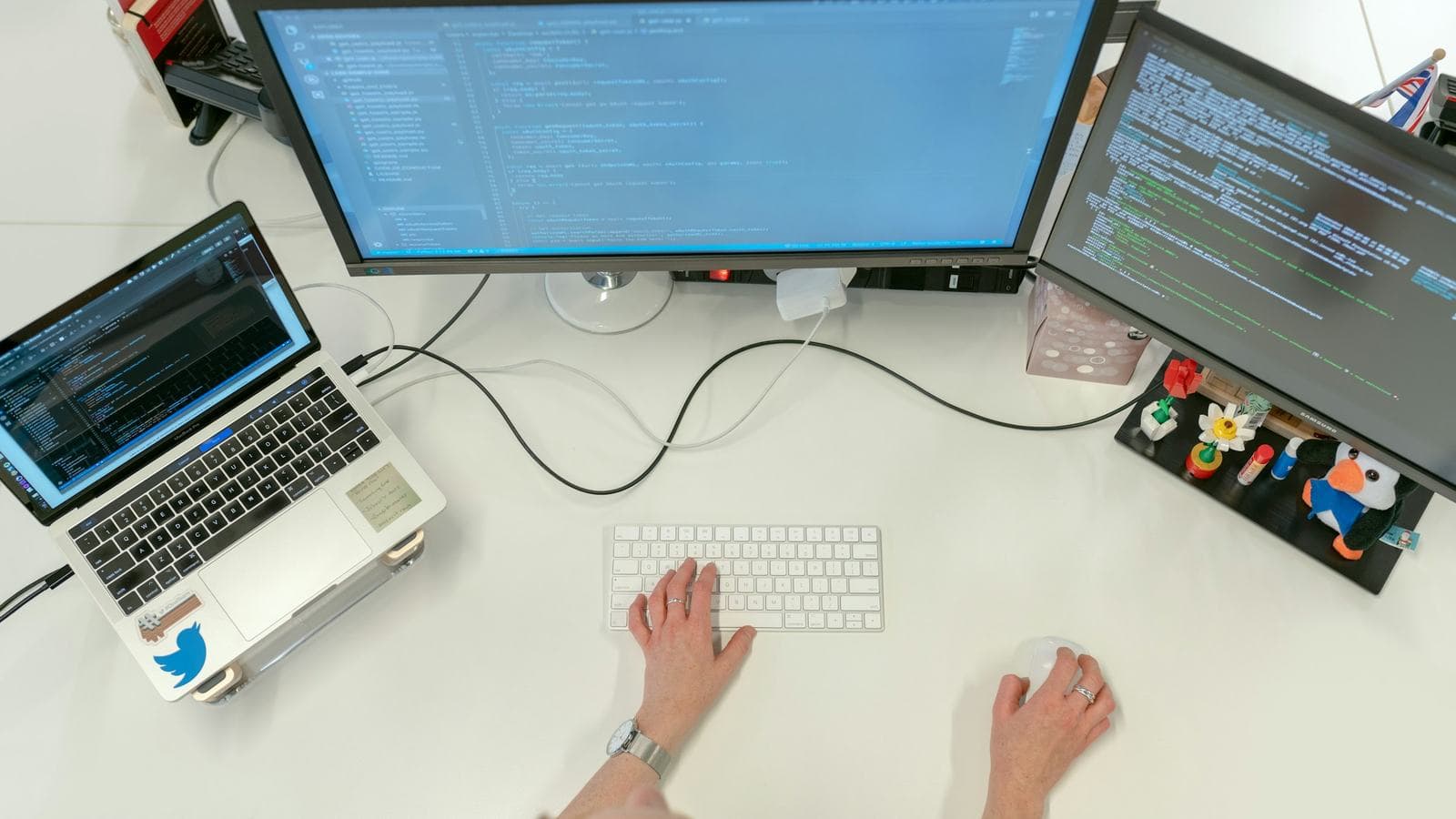 A desk seen from above with a laptop, two monitors full of code, a keyboard and a notebook. Getting the project running on your own machine is often the first hurdle of an internship
Getting stuck, and how to ask for help properly
This is the single biggest difference between interns who do well and interns who struggle, and it has little to do with raw ability.
There are two ways to get it wrong. Some interns ask about everything immediately, before they've tried anything, so their mentor ends up doing the work. Others are so worried about looking incompetent that they stay stuck for two days in silence, and by the time anyone notices, the week is gone.
A simple rule works for most teams: try on your own for 30 to 60 minutes, then ask. Adjust based on what your team tells you. Some teams would rather you ask after 15 minutes.
And when you do ask, ask well. A good question has four parts:
- What you're trying to do. "I'm adding the export button on the orders page."
- What you expected and what happened. "I expected the CSV to download, but I get a 403 from
/api/orders/export." - What you've already tried. "I checked my user has the admin role in the local database, and the route works in Postman with the seed admin's token."
- Your best guess. "I think the new route isn't included in the permissions config, but I can't find where that lives."
A question like that takes your mentor two minutes to answer instead of twenty. Often, just writing it out gets you to the answer yourself. Either way, you come across as someone who respects other people's time, which is exactly what a return offer depends on.
Ask in a public team channel rather than a private message where you can. Someone else probably has the same question, and the answer becomes searchable for the next person.
The intern project and the final demo
At bigger companies, most of your internship revolves around one defined project. Your manager will have scoped it before you arrived: something useful, contained enough for one person in ten or twelve weeks, and not so critical that the company is in trouble if it slips.
Typical examples: a new internal dashboard, a performance improvement on a slow page, a feature flag system for one product area, a tool that automates a manual process the operations team does every week.
The project usually goes through a recognisable arc:
- Weeks 1 to 2: understand the problem, read the relevant code, write a short design document explaining your approach. This document matters. Writing down your plan before coding is a habit that experienced engineers have and most students don't.
- Weeks 3 to 8: build it in small pieces, each one reviewed and merged. Not one giant pull request at the end.
- Weeks 9 to 10: testing, fixing edge cases, writing documentation so the team can maintain it after you leave.
- Final week: a demo or presentation to the team, sometimes to a wider group.
In the demo, the room cares less about how much code you wrote than about what problem it solves, what you decided and why, what went wrong and how you handled it, and what you'd do next. Interns who explain their trade-offs clearly tend to stand out more than interns who built the most.
 A team meeting around a long table with laptops open while one person presents at the front. Most intern projects end with a demo to the team
How you're evaluated, and what decides a return offer
At companies with structured programmes, your manager will write an evaluation at the end, often with input from your mentor and the people who reviewed your code. The exact criteria vary, but they usually come down to a few questions:
- Did you deliver what you set out to, or explain clearly why not?
- Did the quality of your work improve over the internship?
- Did you get unstuck on your own when you reasonably could, and ask when you should?
- Did you take feedback well, and did it show up in your next pull request?
- Would people on the team want to work with you again?
Notice what's missing. Nobody is asking whether you were the best programmer in your batch. A steady intern who improves and communicates well regularly gets a better evaluation than a brilliant one who went quiet for three weeks.
As for the odds: in the US, NACE's 2026 Internship & Co-op Survey found that 63.1% of eligible interns from the 2024-25 cohort accepted a full-time offer, the highest conversion rate in five years, and 88.3% of interns who got an offer accepted it. The same organisation's previous survey found that in-person interns received offers at a noticeably higher rate than hybrid interns (71.9% against 56.2% for the 2023-24 cohort). That second number is worth thinking about if you're choosing between a remote and an in-office internship. Being physically around the team makes it easier for people to see your work and get to know you.
Indian numbers aren't published the same way, and they vary hugely by company. But the pattern holds: the internship is the interview. A strong internship at a company that hires interns full-time is often the most reliable route into that company.
Mistakes that quietly sink internships
Most interns who have a bad time don't fail because of one big disaster. It's usually a few small habits piling up.
Going silent. Nobody minds you being stuck. People mind finding out on Friday that you've been stuck since Monday. Mention blockers in standup, every time.
Building something clever instead of what was asked. If the ticket says "add a filter," don't rewrite the whole page with a new state management library. If you think a bigger change is needed, propose it first.
Huge pull requests. They're hard to review, slow to merge and full of hidden problems. Break your work into pieces.
Not writing anything down. You will be told the same thing twice and forget it both times unless you take notes. Keep a running doc of commands, contacts, acronyms and things you learned.
Treating feedback as criticism. "Can you rename this?" isn't an attack. Say thanks, make the change and move on.
Ignoring the business. The best interns ask why a feature matters, who uses it and what happens if it breaks. Understanding the "why" is what separates engineers who get trusted with bigger work from those who don't.
 A laptop open on a dark desk late in the evening, with code on the screen and a couple of books beside it. The preparation that lands an internship usually happens months before the application goes in
How to actually get a software engineering internship
This is where a lot of advice online assumes you're at a top-tier college with a placement cell that big companies visit. Most students aren't, and that includes most students in Kashmir. So here's what I'd do depending on where you're starting from.
If you're aiming for big tech
Big tech internships are gated mostly by online assessments and interviews built around data structures and algorithms. Arrays, hashing, two pointers, recursion, trees, graphs, sorting, dynamic programming. You don't need to be a competitive programmer, but you do need to solve medium-difficulty problems comfortably and explain your thinking out loud.
It helps a lot to actually see what an algorithm does rather than just memorising code. I built an algorithm visualiser for exactly that: you can step through sorting and searching algorithms one operation at a time and compare them side by side to see why one is faster than another on the same input.
Also look at programmes designed for early students. Google's STEP internship, for example, is aimed at first- and second-year undergraduates, runs in several regions including India, and expects basic DSA and some programming experience. Eligibility and timelines change, so check the current listing on Google's careers site rather than relying on a blog post, this one included.
Apply early. Big companies open intern applications months ahead, often in the second half of the year before the internship.
If you're aiming for startups and smaller companies
Here the gate is different. Smaller companies care much more about what you've already built than about your DSA scores. The strongest signal you can send is two or three real projects that someone other than you actually uses.
"Real" is the important word. A to-do app from a tutorial doesn't count for much. A booking system for your uncle's guest house in Pahalgam, a website for a local shop that takes orders online, or a small tool your college department really uses tells a founder that you can deal with messy requirements, real users and things breaking. That's exactly what they need from an intern.
Then contact companies directly. Not a generic "Respected Sir, I am a hardworking student" email, but something specific: "I've been using your app, I noticed the search doesn't handle Urdu names well, here's a small demo of how I'd fix it, and here's my GitHub." Very few applicants do this, which is why it works.
If you're starting from zero
If you haven't built anything yet, or you're coming in from a completely different path, start with the fundamentals and a plan rather than applying everywhere and hoping. I wrote a free, day-by-day 90-day roadmap called THE PATH for students in Kashmir who want to go from knowing nothing to having a first paying client. The full breakdown of the roadmap is on the blog. A first freelance project or two makes a far stronger internship application than a certificate.
Stipends, unpaid internships and the ones to avoid
Money is where students get the least straight information, so here it is plainly.
Stipends in India vary enormously. Large product companies and well-funded startups in the big tech cities often pay engineering interns tens of thousands of rupees a month, sometimes well above ₹1 lakh at the top end. Smaller companies and agencies commonly pay in the range of a few thousand to around ₹20,000. Many small local firms pay nothing. International remote internships can pay more again, but they're competitive and you should be careful about who's offering them.
An unpaid internship isn't automatically a scam. At a small company where a senior developer genuinely spends time teaching you, a short unpaid stint can be worth it. But be honest with yourself about what you're getting in return.
What you should walk away from:
- "Internships" you have to pay for. If a company charges you a fee for an internship, a certificate or "training," it's selling a course, not offering a job. Legitimate employers don't charge interns.
- Certificate factories. Month-long "virtual internships" where you watch videos, submit a form and receive a certificate. Recruiters have seen thousands of these and they carry almost no weight.
- No one technical to learn from. If you'd be the only person writing code, with nobody to review it, you're not an intern. You're an unsupervised, unpaid developer.
- Vague answers about what you'll work on. A good company can tell you the team, the kind of tasks and who your mentor will be.
- Pressure to decide immediately. Genuine offers give you a reasonable time to accept.
Before accepting any internship, ask three questions: who will review my code, what will I be working on in the first month, and what happened to last year's interns? The answers tell you most of what you need to know.
For business owners: can an intern build your app?
I get asked a version of this fairly often, usually by someone running a shop, a clinic or a travel business who knows a bright student and wonders whether they could build the company's website, app or management system for a stipend.
The honest answer is that interns can do excellent work, when there's an experienced engineer guiding them. Everything that makes an internship work, including the code review, the small scoped tasks, the mentor who spots the N+1 query and the null address, exists because nobody expects a student to make good architecture, security and data decisions alone yet. That's not a criticism of students. It's just where they are in their careers.
When a business puts an intern in charge of its main system with nobody senior around, the problems tend to show up months later, not on day one. The site works in the demo, then slows to a crawl once customers start using it. Customer data sits in a database with weak access rules. Payments work until the edge case nobody tested. The intern graduates and moves on, and nobody else understands how anything was built. Fixing that later almost always costs more than building it properly first.
Where interns genuinely help a small business:
- Keeping website content, product listings and blog posts up to date
- Social media, simple graphics and campaign support
- Testing an app before launch and writing up what's broken
- Small, well-defined changes to a system someone experienced built and maintains
Where you want an experienced developer:
- The first version of a website, app or system your business will depend on
- Anything that handles payments, personal data or medical and financial records
- Integrations between systems, such as inventory, billing, bookings and accounting
- Performance, security and making sure the thing still runs well in three years
That second list is the work I do. I design and build web applications, mobile apps and custom business software, and I write them so that someone else can pick them up later, including a junior developer you might hire. The GOC inventory management platform and the J&K BOSE school management system are two examples of software that has to keep working long after launch, and you can see more in my case studies.
If you're weighing up whether you even need custom software yet, my post on the signs you actually need custom software is a good place to start. If you already know what you want built, you can ask for a quote and I'll tell you honestly what it involves, including which parts a junior could safely handle later.
 Overhead view of a team's shared table with several laptops, phones, notebooks and coffee. Interns do their best work on a team where an experienced engineer reviews and guides them
A quick reality check before you start
If you've got an internship coming up, here's what to do in the weeks before:
- Get comfortable with Git on the command line. Branching, committing, pulling, pushing, opening a pull request and resolving a basic merge conflict.
- Learn the basics of the company's main language and framework. Not mastery, just enough that the code doesn't look alien.
- Practise reading code you didn't write. Pick an open-source project in the same stack and try to trace how one feature works from the button click to the database.
- Set up a notes system. A single running document is enough.
- Sort out your laptop and internet if you're remote. In parts of Kashmir, a backup mobile data connection is not optional. Tell your manager in advance if connectivity is unreliable where you are. It's far better than disappearing from a meeting unexplained.
And go in expecting to feel slow for the first two or three weeks. Everyone does. The interns who do best are the ones who don't let that feeling push them into either silence or panic.
Frequently asked questions
What does a software engineering intern do day to day? Most days include a short standup meeting, a few hours of focused work on a ticket (usually a bug fix, small feature, test or internal tool), responding to code review comments, and a check-in with a mentor or the team. Interns spend more time reading and understanding existing code than writing new code.
Do software engineering interns write real code? Yes. At any decent company, your changes go through the same code review and testing process as everyone else's and end up in the product people use. The tasks are scoped smaller, but the code ships.
How long is a software engineering internship? Summer internships usually run 8 to 12 weeks. In India, many engineering colleges also have a six-month internship in the final semester. Some startups offer three-to-six-month internships year-round.
Do I need to be good at DSA to get an internship? For big tech companies, yes. Their online assessments and interviews focus heavily on data structures and algorithms. For startups, agencies and smaller companies, real projects usually matter more. It's worth being reasonably solid at both.
What happens in the first week of a software engineering internship? Mostly setup and orientation: getting accounts and access, getting the project running on your machine, meeting the team and reading the codebase. You'll usually get a small first ticket by the end of the first week or early in the second, designed to walk you through the full process once.
How much do software engineering interns get paid in India? It varies widely. Large product companies and well-funded startups can pay tens of thousands of rupees a month or more, smaller companies often pay a few thousand to around ₹20,000, and some small firms pay nothing. Never pay a company to intern with it.
What is a return offer? A full-time job offer made to an intern at the end of their internship, usually based on the manager's evaluation. At companies that hire through their internship programme, it's often the most reliable way in.
Is a remote internship as good as an in-person one? It can be, but it takes more effort to stay visible. US data from NACE showed in-person interns received full-time offers at a higher rate than hybrid interns. If you're remote, over-communicate: share progress in team channels, turn your camera on in meetings and ask questions publicly.
Can I get an internship from a tier-3 college or a small city? Yes. The route just looks different. Build two or three projects that people use, contact startups and smaller companies directly with specific, tailored messages, and look at programmes aimed at early-year students. Where you studied matters much less once you can show working software.
Are virtual internship certificates worth it? Mostly no. Programmes where you watch videos and receive a certificate carry very little weight with recruiters. One working project, or one paying client, is worth more than a folder of certificates.
Should my business hire an intern to build our website or app? Only if an experienced developer is guiding and reviewing their work. Interns are great for content, testing and small changes to a well-built system, but the first version of anything your business depends on, especially anything with payments or personal data, should be built by someone experienced. I'm happy to talk through what your project needs if you get in touch.
The part nobody puts on LinkedIn
An internship isn't a test of how much you already know. It's a few months of being allowed to be new, with people around you whose job partly includes helping you get better. The interns who get the most from it are the ones who use that properly: they ask good questions, they take feedback without flinching, they write things down, and they care about why the work matters, not just whether the tests pass.
If you're a student still working towards your first internship, start building things people can use now. The free THE PATH roadmap is a good place to begin, and the algorithm visualiser will help when interview season comes around.
And if you're a business owner who needs software built properly, the kind a junior developer could safely pick up and maintain later, tell me what you're building. I'll give you a straight answer about what it takes and what it costs, and I'll tell you if something simpler would do the job.
Owais Noor
Full-Stack Developer & Digital Marketer, based in Srinagar. I write about building fast, useful websites and software — and getting them found.