What Is Jev AI? How TypeSafe's Decision Model Is Crushing LLM Token Costs

Here's a question to ask about any AI feature you're paying for: how much of what the model writes does anyone ever read?
Take a typical support-routing workflow. A ticket comes in. A language model reads it, then writes a few hundred tokens: a short explanation, a JSON object with a category, a priority and an urgency flag. Your code parses the JSON, throws the explanation away and sends the ticket to a queue. You paid for every one of those tokens and waited for each of them to generate, in order, one after another. All you used was three fields.
That waste is built into how large language models work, and it's the problem a new model called Jev was designed to remove. Jev launched in mid-September 2026 from a San Francisco startup called TypeSafe AI. It doesn't write text at all. You give it a situation and a set of typed questions, and it returns answers with calibrated probabilities in a single pass, typically within a few hundred milliseconds. TypeSafe prices input at $42 per billion tokens, and output costs nothing.
AI engineering circles have been talking about it all week, and reasonably so. Some of the claims are huge ("up to 200x faster", "can't hallucinate"), so below I go through what Jev is, how the "System One" idea works, what the published numbers do and don't show, and where it could realistically cut the cost of an AI feature you already run.
I build AI and automation systems for businesses, and model cost has become the line item clients ask about most. I haven't put Jev into a client's production system yet (it's in early access), so this is an evaluation from the documentation, TypeSafe's own benchmarks and the independent write-ups so far. I've marked which numbers come from the vendor.
At a glance
- Jev is a decision model, not a language model. It takes unstructured input ("state") and returns typed answers: a choice from a list, a score on a scale, or a yes/no probability. It can't write prose, code or summaries.
- TypeSafe calls it the first "System One" model, after Daniel Kahneman's fast, intuitive System 1 thinking. It's built for quick judgement calls, not step-by-step reasoning.
- It's fast because it doesn't generate token by token. A parallel sampler answers every question in one pass, and TypeSafe reports end-to-end latency of 70–500 ms.
- It's cheap because output is free. Input costs $0.042 per million tokens. TypeSafe says that is 238x lower than the input price of Claude Fable 5.1.
- "Can't hallucinate" is narrower than it sounds. Jev can't return a value outside the schema you give it. It can still pick the wrong option.
- The speed and cost numbers come from TypeSafe. Its headline of "40–200x faster, 40–400x cheaper" comes from workflows its own team wrote, and nobody has independently reproduced them at scale yet.
- The practical use is a cascade. Jev handles the high-volume routing, triage and filtering decisions, and an LLM runs only on the cases that need one. That can make the LLM bill a small fraction of what it was.
What is Jev AI?
Jev is a proprietary AI model from TypeSafe AI that returns structured decisions with probabilities instead of generating text. You send it two things:
- State: the situation the model should judge. This can be plain text, a JSON object or an array: a support ticket, a product listing, a job application, a sensor reading, a chat transcript.
- Questions: a set of typed questions about that state, each with a fixed answer space defined up front.
Jev returns an answer to every question, plus a probability distribution over the possible answers and a confidence score. It never returns a paragraph, an explanation or a free-form string.
Here's the full announcement stripped of marketing:
| Developer | TypeSafe AI, San Francisco (founded 2024) |
| Founders | Diogo Almeida (CEO), Erik Gafni, Sasha Sheng |
| Launch | September 2026, in early access |
| Funding | $40M seed round led by DCVC (valuation reported by Forbes at $200M) |
| Model class | "System One": typed, probabilistic decisions |
| Training | Reinforcement Learning for Calibrated Decisions (RLCD), on synthetic data |
| Latency | 70–500 ms end to end (vendor-reported) |
| Pricing | $42 per billion input tokens; output free |
| Outputs | Choice, Score and Noul (yes/no) answers, each with probabilities |
The founding story explains much of the design. Almeida spent about four years at OpenAI on the work that made language models follow instructions: RLHF, InstructGPT, ChatGPT and GPT-4. He left in 2024. In interviews he has described conversational models as "lightning in a bottle": remarkable, but awkward to build dependable software on. Jev is his answer to a narrower question. What would a model look like if it were designed from scratch for software to call, rather than for people to talk to?
The name comes from William Stanley Jevons, the 19th-century economist behind the Jevons paradox: when a resource gets cheaper to use, people tend to use far more of it, not less. TypeSafe is betting that when AI decisions cost almost nothing, companies will put them into many more places. It's a fitting name for a company whose pitch is mostly about price.
 A black-and-white chessboard with one king toppled. Jev is built for the quick judgement calls in a workflow, not for long chains of reasoning
The Jev model explained: a non-generative "System 1" framework
To see why Jev is fast and cheap, start with why ordinary LLMs aren't.
How an LLM makes a decision
A large language model like GPT, Gemini or Claude is autoregressive. It produces one token, appends it to the input, then produces the next token based on everything so far, over and over. Ask it to classify a support ticket and it has to write out the answer, even if the answer is the word "billing." Ask for a structured JSON object with a category, priority, sentiment and a "needs human" flag, and it writes every brace, quote mark, key and value in sequence.
That has three expensive consequences:
- Latency grows with output length. Each token waits for the one before it. Reasoning models are slower still, because they write out long chains of thought before the answer.
- Output tokens cost more. On most frontier models output tokens cost several times as much as input tokens, and for decision tasks the output is the formatting you asked for.
- The format can break. The model is writing JSON, so it can write invalid JSON, a category that doesn't exist, or an explanation where the value should be. Structured-output modes reduce this, but anyone who has run LLM classification at volume has a retry loop somewhere for these failures.
What Jev does instead
Jev skips generation. TypeSafe describes "a new architecture, a new sampler, and a new training algorithm." The sampler works in parallel: every question in a request is evaluated in one pass instead of being written out token by token. Because each question's answer space is fixed in advance, the model doesn't produce an answer so much as assign probabilities across the valid options.
That's what TypeSafe means by "System One." The term comes from Daniel Kahneman's Thinking, Fast and Slow: System 1 is fast, automatic, intuitive judgement (recognising a face, sensing a tone, knowing a sentence is angry), and System 2 is slow, deliberate reasoning (long division, a legal argument). Chat models, especially reasoning models, have spent years moving towards System 2. Jev is built entirely for System 1: quick calls on a bounded set of options, at the volume and speed software needs.
RLCD: training for calibration, not fluency
The training method is called Reinforcement Learning for Calibrated Decisions (RLCD), and the important word is calibrated. A calibrated model's probabilities mean something: when it says 80% confident, it should be right about 80% of the time.
That matters more than it sounds. Each answer Jev returns comes with a confidence score, so you can build rules on it: act automatically above one threshold, send to a person below it, and use a stronger model in between. LLMs can be asked to rate their own confidence, but those self-reported numbers are notoriously unreliable. If Jev's probabilities hold up in real use, they're arguably the most useful thing it offers, more so than the speed.
TypeSafe says Jev was trained only on synthetic data. It hasn't published the architecture, the weights or a peer-reviewed technical paper. It's a closed model, and the details of how it works are mostly the company's own description.
 Long-exposure light trails streaking through a dark frame. Jev's speed comes from answering every question in one parallel pass rather than writing tokens in sequence
TypeSafe AI Jev: a complete guide to the first decision-only model
If you're a developer or a technical founder deciding whether Jev is worth a proof of concept, here's how it works in practice, based on the early-access documentation and the hands-on guides published since launch. The API is new and may change, so check the official docs before building on any detail below.
The three question types
All of Jev's output is built from three primitives:
Choice picks one option from a defined set (up to 255 options). Each option has a short description of when it applies. Typical uses: routing a ticket to a team, tagging a product category, labelling a lead's intent.
Score places the state on an ordered scale of 2 to 10 levels that you describe in words, such as "calm, just stating facts" → "frustrated but civil" → "very angry." The returned score can be fractional, which gives you a finer signal than the level names alone. Typical uses: urgency, sentiment intensity, lead quality, risk level, content relevance.
Noul is TypeSafe's name for a yes/no question. You get a probability between 0 and 1 that a statement is true, such as "this message contains a refund request" or "this listing violates our policy on prohibited items."
Every answer includes the chosen value, the full probability distribution and a confidence score.
What a request looks like
Here's a simplified example in the shape of TypeSafe's Python SDK. It's for illustration, so check the current docs for the exact names:
response = client.system_one(
    state=ticket_text,
    questions={
        "team": Choice(
            instructions="Which team should handle this ticket",
            criteria={
                "billing": "Payments, invoices, refunds or subscription changes",
                "technical": "Bugs, errors or integration problems",
                "sales": "Pricing questions or new purchase enquiries",
            },
        ),
        "urgency": Score(
            instructions="How urgently the customer needs a response",
            criteria=["Routine", "Soon", "Blocking their business"],
        ),
        "wants_refund": Noul(instructions="The customer is asking for a refund"),
    },
)
That's one call, three decisions, one round trip, with no JSON parsing, retries or regex over a paragraph. Adding a fourth or fifth question barely changes the response time, because the questions are evaluated in parallel. You pay only for the extra input tokens the new questions add.
Limits worth knowing before you design around it
Early-access guides report a context limit of around 64k tokens per request (state plus all questions), with a tighter budget for the state plus the longest single question. That's plenty for a ticket, an email thread or a product record. It isn't meant for whole documents or long conversation histories. Filter what you send in code first.
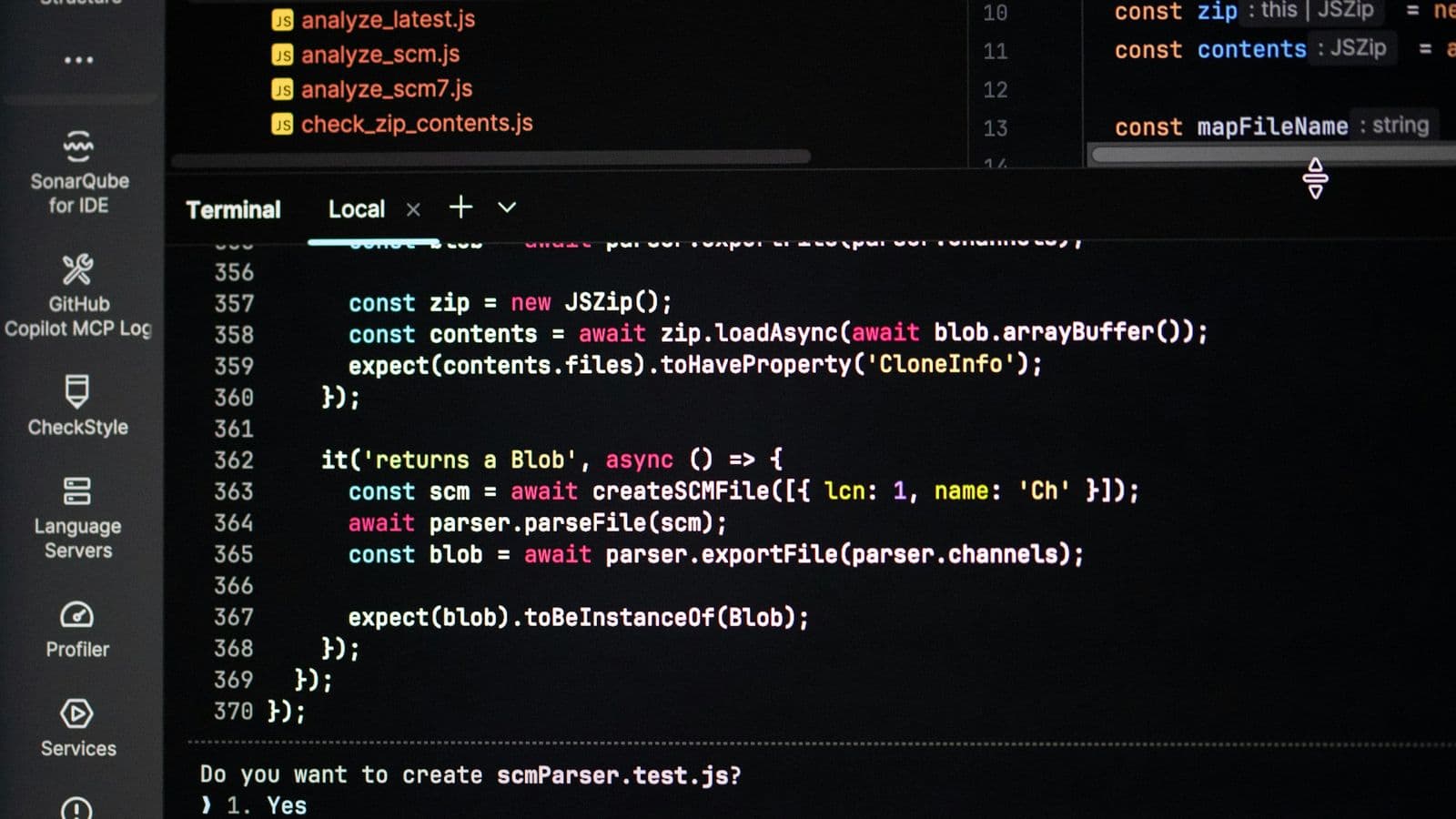 Code in a dark-theme editor. A Jev integration is a single typed call, with no JSON parsing or retry loop around it
Where Jev is weak
The more candid write-ups since launch agree on a list of weaknesses. You should know them before you commit:
- It reads literally. Jev answers the question as written. If your criteria are vague, overlapping or contradict the instructions, you get wrong answers, not a clarifying question. Writing good criteria is most of the work.
- It's poor at arithmetic. Counting, date calculations and ordering are unreliable. Do that in code and send Jev the result.
- Irrelevant input hurts accuracy. Filling the state with material that doesn't matter degrades the answers. Retrieve precisely and send only the fields that matter.
- The state is untrusted input. If users write the text you send, they can try to steer the answer, the same prompt-injection problem LLMs have. Treat it like any other untrusted input.
- There's no rationale. You get a probability, never an explanation. Where a decision needs a written reason for a regulator, an auditor or a customer, Jev on its own isn't enough.
- It needs a known answer space. If you can't list the valid answers up front, Jev can't help.
 An empty headset resting beside an open laptop. Ticket triage and routing is the kind of high-volume, bounded decision Jev was built for
Jev vs. traditional LLMs: why decision models run up to 200x faster than Claude
The "200x faster than Claude" framing has been all over social media, so it's worth checking exactly what was measured.
Where the headline numbers come from
TypeSafe makes three claims at different levels:
- General range: Jev is "40x–200x faster" and "40x–400x cheaper" than frontier LLMs on System One tasks.
- Best-case workflow: on the workflow featured on its home page, Jev ran 193.6x faster and 444.6x cheaper. This is where the "~200x" in most headlines comes from.
- Input price: Jev's input price is 238x lower than Claude Fable 5.1's.
The most detailed comparison published so far is a benchmark TypeSafe ran on its own decision workflows, summarised by DataCamp:
| Model | Accuracy | Cost per case | Latency | Type-error rate |
|---|---|---|---|---|
| Jev | 67.8% | $0.0004 | 0.4 s | 0% |
| GPT-5.6 Terra | 67.9% | $0.0304 | 10.1 s | 0.58% |
| Claude Opus 5 | 73.1% | $0.1761 | 37.8 s | 5.73% |
Vendor-reported. TypeSafe's own capabilities team wrote the evaluation workflows.
A few things stand out:
- Against Claude Opus 5, Jev is about 95x faster (0.4 s vs 37.8 s) and about 440x cheaper per case. It's also about five points less accurate. That's the real trade-off, and TypeSafe doesn't hide it.
- Against GPT-5.6 Terra, accuracy is essentially identical, while Jev is about 25x faster and about 76x cheaper.
- Type errors drop to zero, and at volume that's often worth as much as the speed. A 5.73% malformed-output rate means one decision in eighteen needs a retry, a fallback or a person to look at it.
So "200x faster than Claude" is roughly right as a best case on TypeSafe's own showcase, and misleading as a general rule. The honest version is that for bounded decision tasks, Jev is one to two orders of magnitude faster and cheaper than a frontier model, with accuracy close to the mid-tier models and somewhat below the best.
Why it's so much faster
The speed follows from the architecture described above:
- No sequential generation. A frontier LLM producing 300 output tokens makes 300 sequential steps. Jev evaluates the questions in one pass.
- No reasoning overhead. Reasoning models spend thousands of hidden tokens thinking before they answer, which is why Claude Opus 5 took 37.8 seconds per case above. Jev doesn't reason in that sense at all.
- Questions run in parallel. Asking an LLM ten things means a longer output or ten calls. Asking Jev ten things costs about the same time as asking one.
- No validation loop. No JSON to parse, no schema to check, no retry when the model makes up a category.
Head-to-head: what each is for
| Jev (System One) | Frontier LLM | |
|---|---|---|
| Output | Typed answers + probabilities | Free-form text, code, JSON |
| Typical latency | 70–500 ms | Seconds to minutes |
| Output token cost | Free | Usually several times the input price |
| Invalid output | Impossible by design | Possible; needs validation |
| Explains its answer | No | Yes |
| Handles open-ended tasks | No | Yes |
| Multi-step reasoning | No | Yes |
| Best for | Routing, triage, scoring, filtering, guardrails | Writing, summarising, coding, complex judgement |
The conclusion isn't that one model is better. They do different jobs. Most real AI features include some of each, and most of them use a frontier LLM for all of it.
 Coins stacked in rising columns. Jev's pricing comes down to never paying for output tokens you'd throw away
How Jev is crushing LLM token costs
This is the part that matters for a budget. Jev's cost advantage has three sources, and they compound.
1. Output tokens cost nothing
For decision tasks, output is where the waste is. You pay premium output rates for the model to write out an answer you'll parse into a single field. Jev charges only for input. The output that makes up much of a typical LLM bill for classification disappears from the invoice.
2. Input is priced far lower
At $0.042 per million input tokens, Jev is well below even the budget models most teams use to save money on classification. TypeSafe's own comparison puts frontier input pricing between roughly $0.20 and $10 per million tokens. That's about 5x to 240x more on input alone, before output is counted.
3. You stop paying for the system around the model
This part is hard to see on the invoice. An LLM-based decision system has costs beyond tokens: retry logic for malformed outputs, validation code, fallback paths, and the engineering time spent maintaining prompts that coax valid JSON out of a model. Constrained output removes a whole category of that code.
A worked example
Take a business that runs one million incoming messages a month through an AI triage step: support tickets, WhatsApp enquiries, form submissions and reviews. Say each request, with the message and the question definitions, averages 1,500 input tokens. That's 1.5 billion input tokens a month.
- With Jev: 1.5 billion × $42 per billion = about $63 a month, with no output charges.
- With a frontier model at a hypothetical $3 per million input tokens: about $4,500 a month on input alone, before output tokens, retries and the latency cost of multi-second responses sitting in your request path.
These are illustrative numbers, not a quote. Your token counts and your current model's price will differ. But the size of the gap holds: for pure decision work, the cost can drop from thousands of dollars a month to tens. For a small or mid-sized business, that can decide whether an AI feature is too expensive to run or cheap enough to put on every message.
That's the Jevons paradox the product is named after. When a decision costs a fraction of a cent and returns in a third of a second, you can put one on every incoming message, every listing, every log line and every step of a workflow, including the places where an LLM was never affordable.
 A rendered circuit board with a glowing central chip. In a well-designed system, a cheap decision layer sits in front of the expensive models and routes the work
The real play: cascades, not replacement
The most common misreading of Jev is that it replaces your LLM. It doesn't, and the teams that get the most out of it won't use it that way. The pattern that works is a cascade: a cheap, fast decision layer that handles most of the traffic and sends only the hard cases to an expensive model.
A support pipeline built this way looks like this:
- Jev reads every incoming message and returns intent, urgency, sentiment and a few yes/no flags in one sub-second call.
- Low-confidence answers go to a human. When the probabilities are close, a person should look, and the calibration is what makes that threshold usable.
- Simple, high-confidence cases are handled in code. An order-status question needs a database lookup, not a model. Most teams are surprised how much of their volume falls here.
- Only complex cases reach the LLM, such as a detailed complaint or a nuanced technical question, where you want written reasoning and a drafted reply.
In a pipeline like this, the expensive model only sees the hard cases instead of all the traffic. Your LLM bill drops, average response time drops, and the LLM's output is better because it only gets the cases that need it.
Two more patterns are worth knowing:
- Filtering before a large context window. Before sending 200 candidate documents into an LLM prompt, have Jev score each one for relevance and send only the top few. You pay much less for input, and the answer usually improves because the model isn't wading through noise.
- Guardrails on LLM output. Run every LLM response through a set of fast yes/no checks before it reaches a customer: "contains a price commitment," "mentions a competitor," "includes personal data." That's a cheap, sub-second safety check, which has always been hard to afford with a second LLM call.
I wrote about the same principle, the right model for each step, in my guide to custom AI automation. What's new is that the cheap end of that range just got much cheaper and much faster.
Why everyone is talking about Jev, TypeSafe AI's new text-free model
A new model launches most weeks. Here's why this one broke through:
The founder's background. A model from someone who helped build ChatGPT, arguing that chat is the wrong interface for most software, is going to get attention. So is a large seed round led by DCVC.
It questions a default. Since 2023, "add AI" has meant "call an LLM." Jev argues that for a large share of production AI calls, the ones that route, tag, score and filter, generating text was never needed. Most engineers who've shipped an LLM classifier recognise that immediately.
Token costs hurt. After two years of AI features going into production, many businesses are now paying for them at real volume. A model that says it can take most of those calls off the bill is going to get a look from finance teams, not just engineers.
"Can't hallucinate" is a strong claim. It's also easy to misread. Jev can't produce a value outside the schema you define, and by construction it has a 0% type-error rate. It can choose the wrong valid option, and on TypeSafe's own benchmark workflows it did so about a third of the time. It won't make up a category, but it can put a ticket in the wrong one. That's still a real improvement, as long as you read the claim correctly.
It's more than customer support. TypeSafe's demos include real-time uses such as games, simulations, and driving and drone control in simulators, where a decision loop needs answers in milliseconds, not seconds. Commentators have rightly pointed out that none of this has been shown on physical hardware yet. Still, a sub-second model with calibrated confidence opens up uses where LLM latency was a non-starter.
Should your business use Jev? An honest checklist
For most small and mid-sized businesses the question isn't "should we use Jev?" It's "which of our AI calls are decisions pretending to be generation?" Answer that and the rest follows.
Jev is likely a good fit if:
- You already run an LLM for classification, routing, tagging or scoring, and the token bill or the latency bothers you.
- You handle high volumes of similar inputs: tickets, enquiries, leads, reviews, listings, transactions, log events.
- The valid answers can be listed up front, and a probability is more useful to you than an explanation.
- You need decisions inside a request path, where a multi-second LLM call would slow down the user.
- You want a cheap guardrail layer on top of LLM output you already generate.
Wait, or keep using an LLM, if:
- The task needs written output: replies, summaries, code, reports.
- Each decision needs a written rationale for compliance or audit.
- You make a small number of high-stakes, complex decisions where five points of accuracy matter more than the cost.
- You're in a regulated setting that requires model transparency, published architecture or on-premise deployment. Jev is a closed, hosted, early-access model.
- You need independently verified performance before you commit. That doesn't exist yet.
What I'd do this quarter:
- Audit your AI calls. List every place your product calls an LLM, how often, what it costs and what you do with the output. Flag every call whose output you parse into a fixed field.
- Pick one high-volume decision with a labelled history, meaning past cases where you know the right answer.
- Run Jev and your current model side by side on a few hundred of those cases. Measure accuracy, latency, cost and how well the confidence scores separate right from wrong.
- Decide on your own data, not on vendor benchmarks, including this article's summary of them.
If Jev wins, you'll have one cheaper workflow and a pattern to repeat. If it loses, you'll have a proper evaluation set, which most AI features don't have and should.
 A team gathered around a whiteboard in a planning session. The value comes from deciding which calls should be decisions, not from swapping models
Where this fits in the systems I build
Most of the AI and automation work I do isn't about picking the most impressive model. It's about getting the right answer at the right cost, inside software a business already runs. In practice that means:
- Auditing the AI you already pay for. Finding the calls that are really decisions, the prompts sending far too much context, and the flows where a rule or a database lookup would do the job for free.
- Designing cascades. Cheap decision layers first, rules and code where the logic is fixed, human review where confidence is low, and a frontier model only where the task needs one. Jev is now one of the candidates for that first layer.
- Building the evaluation set that lets you switch models on evidence rather than on headlines.
- Putting it inside real software. AI features only pay off inside the systems people use every day. That's the custom software and web application work I've been doing since 2018, from inventory platforms to pharmacy ERPs, where fast, dependable decisions matter more than clever text.
If you're newer to this, a few earlier guides are useful background: how AI agents work and when you don't need one, what goes into a production AI chatbot, and the signs your business has outgrown off-the-shelf software.
 A developer's desk at night: a backlit keyboard, code on the monitor and a desk clock. Adopting a new model well is mostly careful engineering around it
Frequently asked questions
What is Jev AI? Jev is an AI model from TypeSafe AI that makes structured decisions instead of generating text. You give it unstructured input and a set of typed questions, and it returns an answer to each (a choice, a score or a yes/no probability) with calibrated probabilities and a confidence score. It launched in early access in September 2026.
Who made Jev? TypeSafe AI, a San Francisco company founded in 2024 by Diogo Almeida, Erik Gafni and Sasha Sheng. Almeida, the CEO, previously spent about four years at OpenAI working on RLHF, InstructGPT, ChatGPT and GPT-4. The company raised a $40 million seed round led by DCVC.
What is a "System One" AI model? It's TypeSafe's name for models that make fast, intuitive, bounded decisions, after Daniel Kahneman's System 1 thinking. A System One model takes unstructured state and returns typed, probabilistic answers in a single parallel pass, instead of writing text token by token like a language model.
Is Jev an LLM? No. TypeSafe describes it as a new architecture with a parallel sampler and a new training method, Reinforcement Learning for Calibrated Decisions. It doesn't generate natural language, so it isn't a language model in the usual sense, although it reads natural-language input.
Is Jev really 200x faster than Claude? Only in the best case, and on TypeSafe's own numbers. Its showcase workflow reports 193.6x faster and 444.6x cheaper than a frontier LLM. In its published benchmark, Jev answered in 0.4 seconds against 37.8 seconds for Claude Opus 5 (roughly 95x faster), at about 440x lower cost per case, and about five points lower accuracy. Nobody has independently reproduced these results at scale yet.
How much does Jev cost? TypeSafe prices input at $0.042 per million tokens ($42 per billion) and doesn't charge for output. It's in early access, so pricing and availability may change.
Can Jev hallucinate? It can't return a value outside the answer space you define, so it can't invent a category or return malformed output. That's what TypeSafe means by "can't hallucinate." It can still choose the wrong valid answer, so accuracy and confidence thresholds still matter.
Can Jev write text, code or summaries? No. Jev produces no free-form output at all, not even a rationale for its answers. For writing tasks you still need a generative model, and in most real systems Jev works alongside one rather than replacing it.
What is Jev good for? High-volume, bounded decisions: routing and triaging tickets, classifying enquiries and leads, content moderation, scoring relevance before sending documents into an LLM's context, tagging products or records at scale, guardrail checks on LLM output, and decisions inside real-time loops where latency matters.
What are Jev's main limitations? It needs a known answer space, gives no written explanation, reads instructions literally, is weak at counting and date arithmetic, loses accuracy when the input is padded with irrelevant material, and is a closed, early-access model with vendor-reported benchmarks. It's also slightly less accurate than the best frontier models on hard cases.
Will Jev replace ChatGPT or Claude? No, and it isn't trying to. It replaces the decision calls that were going to those models: the classification, routing and scoring steps inside larger workflows. Anything that needs writing, conversation or multi-step reasoning still needs a generative model.
Can you help me work out if Jev would cut our AI costs? Yes. I can audit where your product or workflows call a language model, identify which calls are really decisions, and run a side-by-side evaluation on your own data so you know the accuracy, speed and cost difference before changing anything. Get in touch with a short description of what your AI features do today.
The short version
Jev is the clearest sign so far that "use an LLM" isn't always the right answer for AI in production. Concretely:
- It's a decision model, not a text model: typed answers with calibrated probabilities, in one parallel pass.
- It's fast because it doesn't write, with 70–500 ms responses and extra questions adding almost no time.
- It's cheap because output is free, and input is priced at $42 per billion tokens.
- Treat the headline numbers as vendor claims. "200x faster than Claude" is a best case. Roughly 95x faster, 440x cheaper and five points less accurate than Claude Opus 5 is the more careful reading of the published benchmark.
- Use it in a cascade: Jev for high-volume decisions, code for fixed logic, people for low-confidence cases, and an LLM only where you need written output.
- Test it on your own data before you trust anyone's benchmark.
The businesses that benefit most won't be the first to adopt Jev. They'll be the ones that know which of their AI calls are decisions. If you want help finding them, or you're planning an AI feature and want it built for the right cost from the start, tell me what you're working on. I'll give you an honest assessment of where a decision model fits, where an LLM is still the right tool, and where plain code will do the job for free.
Ready to move? Request a quote, look through my AI & Automation service and case studies, or read what clients have said about working with me.
Owais Noor
Full-Stack Developer & Digital Marketer, based in Srinagar. I write about building fast, useful websites and software — and getting them found.